
LAB REPORT EXPLAINED · KLOW 80 MG
A complete laboratory report brings useful detail to a multi-peptide blend. This KLOW certificate lets you explore the measured components, read the original evidence and check the record directly with the issuing laboratory.
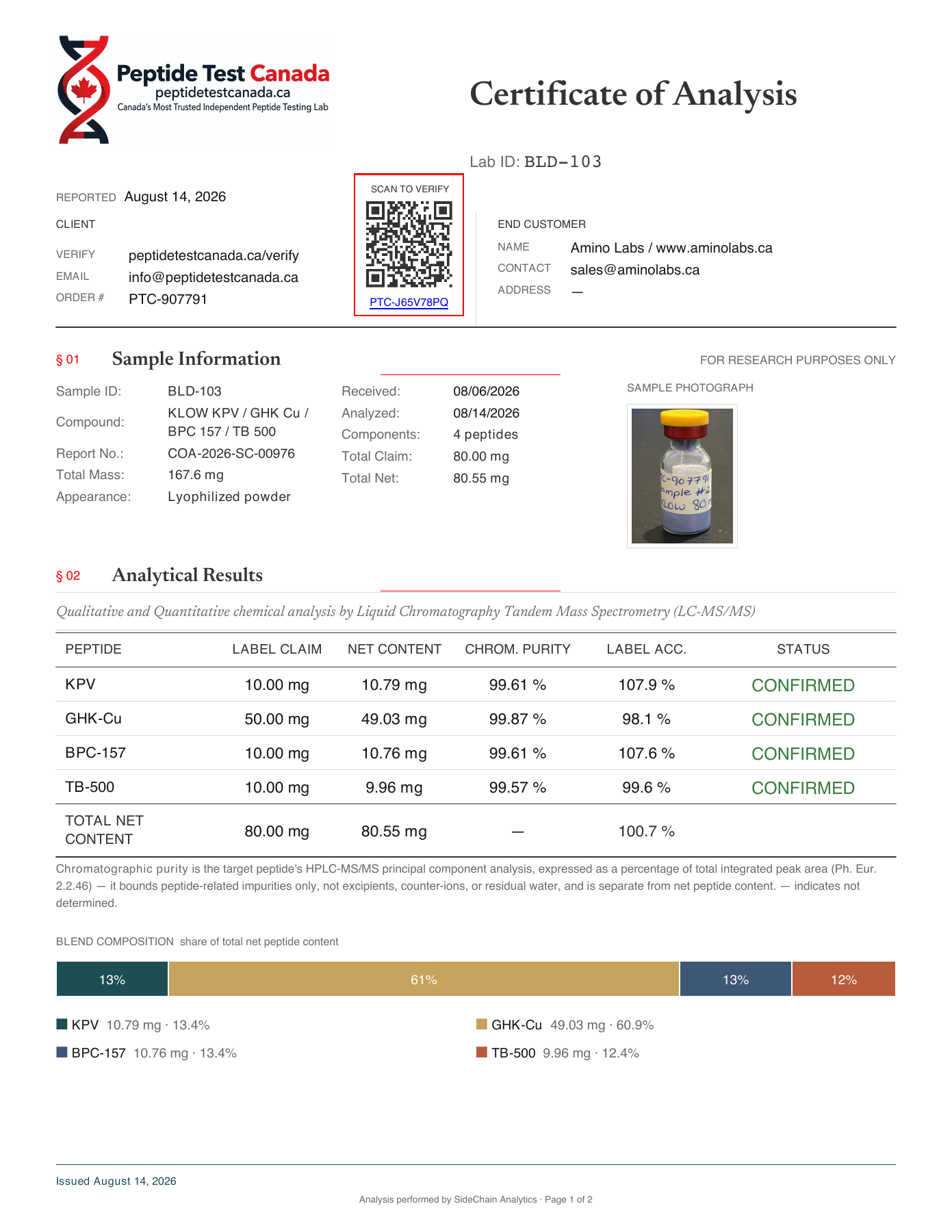
Certificate COA-2026-SC-00976 reports 80.55 mg total net peptide content for KLOW sample BLD-103, compared with an 80.00 mg claim. Its four component results range from 99.57% to 99.87% chromatographic purity. These findings describe the submitted sample.
KLOW 80 mg: laboratory report
80.55 mg total net peptide content; component purities range from 99.57% to 99.87%.
Submitted sample BLD-103 · Report COA-2026-SC-00976 · PDF date August 14, 2026. These results apply to this submitted sample; match your product’s batch documentation before applying them to another vial.
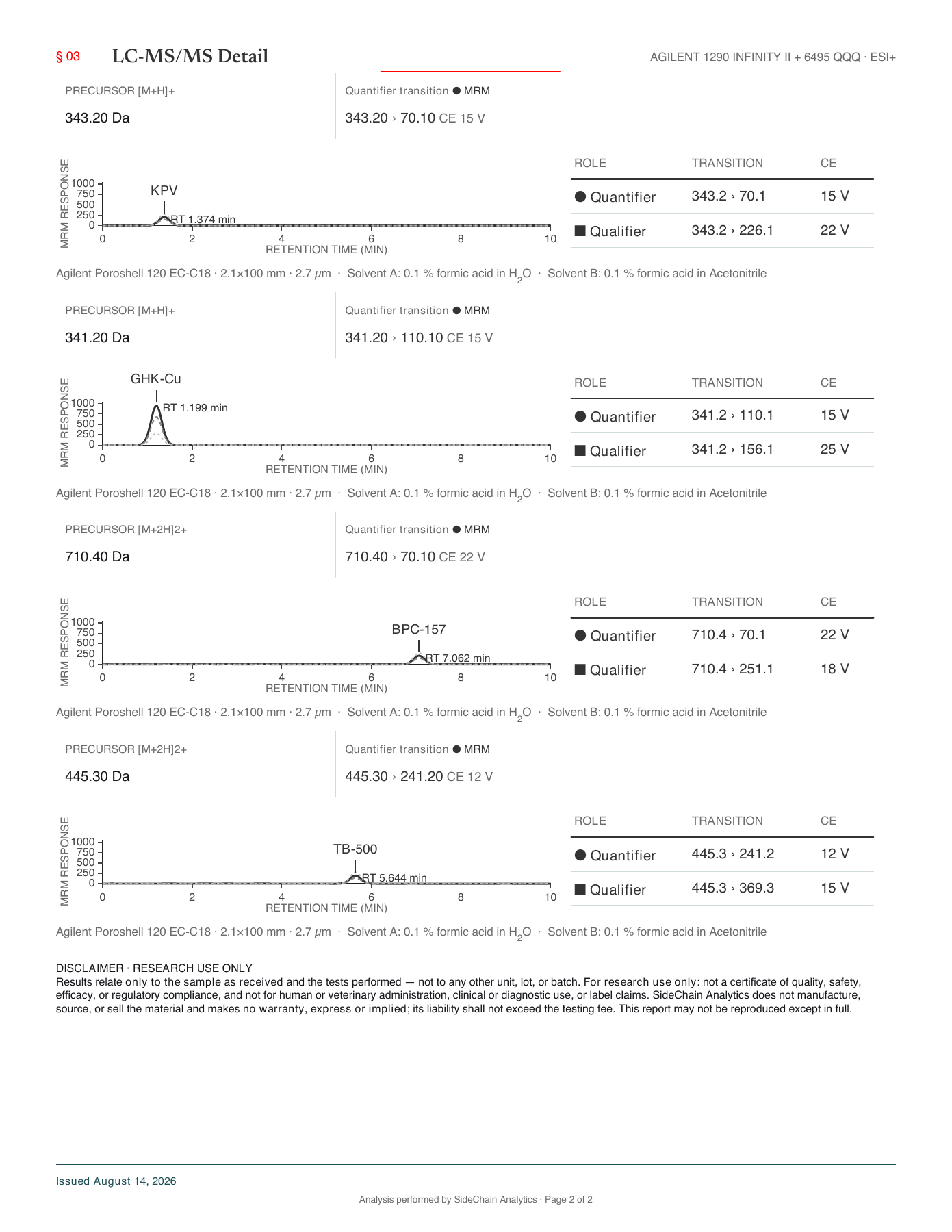
Every page of the actual certificate is displayed below. Select a page to enlarge it, including its original QR code.
How to verify this report with the lab
- Scan the original QR code on page 1 with a phone camera. On the same phone, open the laboratory verification page instead.
- Enter PTC-J65V78PQ and select Verify. Check for the certificate confirmation and portal issue date August 15, 2026.
- Open the lab-hosted PDF. Match sample BLD-103, report COA-2026-SC-00976, PDF date August 14, 2026, formulation and analytical results to the pages shown here. The portal sample label is BLD-103_Blend_CoA_20260814_054957.
Date distinction: the PDF is dated August 14, 2026; the verification portal lists August 15, 2026. These are displayed separately because the portal does not explain the difference.
We checked the laboratory record and confirmed that its downloadable PDF exactly matches the supplied file. Compare the lab-hosted PDF ↗. This is document verification, not independent retesting. The report does not establish sterility, endotoxin levels, storage stability, clinical effectiveness or safety for human use, and does not validate dosing guidance.
What is in this KLOW 80 mg sample?
The certificate identifies a four-peptide blend: GHK-Cu, BPC-157, TB-500 and KPV. The stated formulation is 50 mg GHK-Cu plus 10 mg of each of the other three components. Together, those label claims add to 80 mg.
The blend name alone is not enough to identify a formulation. When reviewing a product or comparing research materials, match the component names and individual amounts to the certificate. This article describes the formulation on this specific report.
KLOW lab results: claimed versus measured content
| Peptide | Label claim | Net content | Chrom. purity |
|---|---|---|---|
| GHK-Cu | 50.00 mg | 49.03 mg | 99.87% |
| BPC-157 | 10.00 mg | 10.76 mg | 99.61% |
| TB-500 | 10.00 mg | 9.96 mg | 99.57% |
| KPV | 10.00 mg | 10.79 mg | 99.61% |
The report gives a total of 80.55 mg, or 100.7% of the total label claim. Adding the displayed, rounded component values gives 80.54 mg—a 0.01 mg difference consistent with rounding. The certificate’s stated total is retained here.
The overall total does not mean every component exactly matches its claim. GHK-Cu is reported at 49.03 mg against 50 mg, while KPV and BPC-157 are each above their individual 10 mg claims. Looking at each row preserves this detail.
Why 99% purity does not mean 99% of the powder weight
The certificate separates chromatographic purity from net peptide content. Purity refers to the target component’s share of the integrated analytical signal described by the report. Net content is the reported peptide quantity in milligrams.
Its purity footnote excludes excipients, counterions and residual water from what that percentage describes. The report also lists 167.6 mg as total mass, alongside 80.55 mg as total net peptide content. Those are different fields; 167.6 mg should not be presented as the amount of active peptide.
Nor should the purity percentages be averaged into one new “blend purity” figure. The certificate reports a separate percentage for each component and does not provide a total-blend purity result.
What was verified?
The public certificate check accepted verification code PTC-J65V78PQ and returned sample record BLD-103_Blend_CoA_20260814_054957, with a portal issue date of August 15, 2026. The PDF itself is dated August 14, 2026. The full two-page document names SideChain Analytics as the analysis provider.
Page two supplies LC-MS/MS details for all four named components, including retention times and monitored transitions. This provides more context than a cropped percentage or a product-page claim. Checking the issuer’s record confirms that the document is present in that record system; it does not independently reproduce the laboratory measurements.
What the report does not establish
The certificate limits its results to the sample received and the tests performed. It does not establish uniformity across other vials or batches. The document contains no sterility, endotoxin or long-term stability result, and it is not evidence of clinical effectiveness or suitability for human use.
A single analysis also cannot establish how a blend changes after reconstitution or storage. Those questions require appropriate stability data collected over time. See the storage-study explainer for why a time-course study answers a different question from a one-time certificate.
How to use these findings in a research review
Record the sample ID, report number, issue date, component quantities and methods together. Compare each ingredient with its own claim, keep powder mass separate from peptide content, and confirm that any material under review can be linked to the tested sample. This makes the certificate useful without extending it beyond its evidence.
For a step-by-step walkthrough, read how to read a peptide certificate of analysis.
Certificate COA-2026-SC-00976; sample BLD-103; issued August 14, 2026; verification code PTC-J65V78PQ. Both pages reviewed. View the complete laboratory certificate. Numbers above are reported results, not independent retesting. Educational report interpretation; no dosing recommendation.