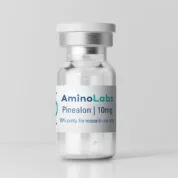
Quickstart Highlights
Pinealon is the Khavinson tripeptide Glu-Asp-Arg (EDR), a short synthetic peptide modeled on pineal-gland peptide fractions. It is studied for neuroprotection, memory and attention, and circadian support, with human evidence limited to small Russian open-label cohorts that used oral capsules; no injectable dose has been studied in humans, and sources disagree roughly 50-fold on the subcutaneous amount. This educational protocol presents the conservative community tier, consistent with the site’s Cardiogen page: 200–300 mcg once daily in the morning for a 10-day course (extendable to 20 days), repeated 2–3 times per year, with 500 mcg as an upper reference, using a 2 mL reconstitution of the 10 mg vial (5 mg/mL).
- Reconstitute: Add 2 mL bacteriostatic water → 5 mg/mL concentration.
- Dose range: 200–500 mcg (0.2–0.5 mg) once daily in the morning, subcutaneously, for a 10-day course (up to 20 days), repeated 2–3 times per year.
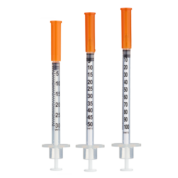
- Easy measuring: At 5 mg/mL, 1 unit = 0.01 mL = 50 mcg on a U-100 insulin syringe.
- Storage: Lyophilized: freeze at −20 °C (−4 °F); after reconstitution, refrigerate at 2–8 °C (35.6–46.4 °F) and use within 28 days.
- Label: No approved label exists. Injectable figures in sources range from 100 mcg to 5 mg per day; this page presents the conservative tier, and no human study has used injectable Pinealon at any dose.
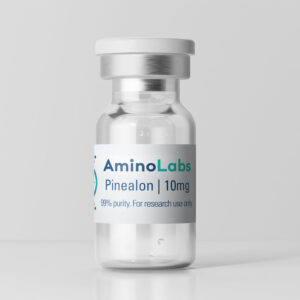
Dosing & Reconstitution Guide
Course Protocol (2 mL = 5 mg/mL)
| Phase | Dose | Calculated volume | U-100 scale value (1 mL capacity) | V1 nominal setting (units) |
|---|---|---|---|---|
| Days 1–10 (standard course) | 200 mcg (0.2 mg) | 0.04 mL | 4 units | 4 units |
| Days 1–10 (upper course dose) | 300 mcg (0.3 mg) | 0.06 mL | 6 units | 6 units |
| Extended course to day 20 | 300 mcg (0.3 mg) | 0.06 mL | 6 units | 6 units |
| Upper reference | 500 mcg (0.5 mg) | 0.1 mL | 10 units | 10 units |
Calculation basis: The table uses the labelled 10 mg amount and assumes a final solution volume of 2 mL (5 mg/mL). BAC volume does not change the amount of peptide. These are nominal calculations, not validation of preparation, compatibility or treatment.
Frequency: Once daily in the morning for 10 days (up to 20). Repeat the course 2–3 times per year.
Cycle: 10–20 day course, repeated 2–3 times per year.
Reconstitution Steps
- Allow the vial to reach room temperature before opening to minimize condensation.
- Draw 2 mL bacteriostatic water with a sterile syringe.
- Inject slowly down the vial wall to minimize foaming; avoid shaking.
- Gently swirl or roll the vial until the powder is fully dissolved.
- Label the vial with the reconstitution date and refrigerate at 2–8 °C (35.6–46.4 °F), protected from light.
- Use reconstituted solution within 28 days for maximum potency and safety.
Important: This guide is for educational purposes only and is not medical advice. For research use only. Not for human consumption.
Supplies Needed
Plan based on a 10–20 day once-daily course; one 10 mg vial covers either course length within the 28-day window.
- Peptide Vials (Pinealon, 10 mg each):
- 10 days ≈ 1 vial (2–3 mg total used at 200–300 mcg/day)
- 20 days ≈ 1 vial (4–6 mg total used at 200–300 mcg/day)
- Insulin Syringes (U-100):
- Per week: 7 syringes
- 10 days: 10 syringes
- 20 days: 20 syringes
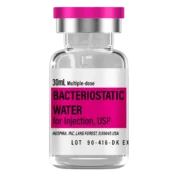
- Bacteriostatic Water (30 mL bottles): Use 2 mL per vial for reconstitution.
- 10 days (1 vial): 2 mL → 1 × 30 mL bottle
- 20 days (1 vial): 2 mL → 1 × 30 mL bottle
Note: Use bacteriostatic water within 28 days after opening; a vial reconstituted more than 28 days after the bottle was first opened needs a new bottle.
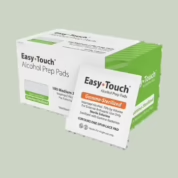
- Alcohol Swabs: One for the vial stopper + one for the injection site each injection.
- 10 days: 20 swabs
- 20 days: 40 swabs
Protocol Overview
Concise summary of the short once-daily course.
- Goal: Support neuronal resilience, memory and attention through the Khavinson bioregulator framework, in short repeated courses rather than continuous use.
- Schedule: Once-daily subcutaneous injections in the morning for 10 days, extendable to 20 days, with the course repeated 2–3 times per year.
- Dose Range: 200 mcg (0.2 mg) to 300 mcg (0.3 mg) once daily for the standard and extended courses, with 500 mcg (0.5 mg) once daily as the upper reference.
- Reconstitution: 2 mL per 10 mg vial (5 mg/mL) for accurate unit measurements on standard insulin syringes.
- Storage: Lyophilized frozen at −20 °C (−4 °F); reconstituted refrigerated at 2–8 °C (35.6–46.4 °F); use within 28 days; avoid repeated freeze–thaw cycles.
- Evidence: Human data are small Russian open-label oral cohorts (Nazimko 2012, n=32; a traumatic brain injury cohort, n=72); otherwise animal and in-vitro work. No injectable dose has been studied in humans and sources disagree about 50-fold, so confidence is low; only the 10–20 day course, the 2–3 courses per year cadence and morning timing are consistent across sources.
Dosing Protocol
Suggested short-course approach based on the Khavinson bioregulator convention and community sources; no clinical injectable dose exists.
- Days 1–10 (standard course): 200 mcg (0.2 mg) once daily in the morning, the standard presentation on this page.
- Days 1–10 (upper course dose): 300 mcg (0.3 mg) once daily, the top of the conservative 100–300 mcg community tier.
- Extended course to day 20: 300 mcg (0.3 mg) once daily continued through day 20 where the course is extended; 20 days is the longest course in the bioregulator convention.
- Upper reference: 500 mcg (0.5 mg) once daily is the highest amount this page presents; it sits at the top of the Cardiogen tier and well below the milligram-level figures in high-tier sources, which this page does not adopt.
- Frequency: Once per day (subcutaneous injection) for the duration of the course.
- Timing: Morning, as on the rest of this page (early afternoon at the latest); two sources report restlessness and a raised heart rate with evening dosing.
- Cycle: 10–20 day course, repeated 2–3 times per year with 2–6 months between courses; no maintenance phase.
Storage Instructions
Proper storage preserves product quality and efficacy.
- Lyophilized (powder): Store at −20 °C (−4 °F) for long-term storage or at 2–8 °C (35.6–46.4 °F) for short-term storage, protected from light and humidity.
- Reconstituted (solution): Refrigerate at 2–8 °C (35.6–46.4 °F) and do not freeze. Use within 28 days; one source gives an explicit 30-day figure and the others describe a limited window.
- Allow vials to reach room temperature before opening to minimize condensation uptake.
- One vial per course: A single 10 mg vial covers a full 20-day course at any dose on the table (6 mg at 300 mcg per day; 10 mg at 500 mcg per day, which uses the entire vial with no margin for draw loss) inside the 28-day window, so one reconstitution serves the whole course.
Important Notes
Practical considerations for consistency and safety.
- Use new sterile insulin syringes for each injection; dispose in a proper sharps container.
- Rotate injection sites systematically (abdomen, thighs, upper arms) to reduce local irritation and avoid lipohypertrophy.
- Evidence caveat: No Phase 1 safety study of Pinealon in humans has been published in indexed English-language literature, there are no registered trials, and every injectable protocol online comes from vendors, forums or the originating research group’s framework. Three of nine sources reviewed decline to give any dose for that reason.
- Why the conservative tier: Sources range from 100 mcg to 5 mg per day for injection. This page presents 200–500 mcg per day, which matches three independent community sources and the site’s Cardiogen page; the milligram-level tier would place Pinealon alongside Crystagen and Cartalax without any added human evidence.
- Route note: The only published human studies used oral capsules at 100–200 mcg twice daily for 2–4 weeks; subcutaneous injection is a community convention extrapolated from Khavinson-group injectable work on Epitalon and Epithalamin, not from Pinealon itself.
- Regulatory status: Not approved anywhere as a drug; sold in Russia as a 0.1 mg cytogen dietary-supplement capsule. Not approved by Health Canada or the FDA; research use only.
- Safety signal: One study flagged a prooxidant effect and a drop in CD34 progenitor markers; long-term human safety is unknown.
- Keep courses short and spaced: the 10–20 day course and the 2–6 month gap are the two features all sources agree on. Community stacks run Pinealon alongside Epitalon or other bioregulators within the same window; this page does not present stacking.
How This Works
Pinealon is the Khavinson tripeptide Glu-Asp-Arg (EDR), a synthetic short peptide modeled on pineal-gland peptide fractions and classed as a cytogen or bioregulator. In vitro it penetrates cells and is proposed to bind the major groove of DNA at gene promoter regions, altering the expression of genes involved in antioxidant defense, apoptosis and synaptic plasticity. In neuronal cell models the result is lower accumulation of reactive oxygen species, less necrotic cell death and improved neuron survival, and an Alzheimer’s model reported a 71% increase in dendritic spine density. Those findings are the basis for its cognitive and neuroprotective claims. Human evidence is confined to small open-label Russian cohorts using oral capsules at 100–200 mcg twice daily, with reported improvements in memory and attention; no injectable dose has been studied in humans, which is why this page presents a conservative tier and short, spaced courses rather than a titration.
Potential Benefits & Side Effects
Observations from cell and animal models and small open-label human cohorts.
Potential Benefits:
- Neuroprotection: reduced reactive-oxygen-species accumulation and necrotic cell death in neuronal cell models.
- Memory, attention and mental clarity in small Russian open-label cohorts; community reports describe reduced brain fog, though one source notes the effects are subtle and hard to distinguish from placebo.
- Increased dendritic spine density (71% reported) in an Alzheimer’s model.
- Sleep quality and circadian normalization in community reports, with a pineal-derived rationale rather than trial data.
- Geroprotective claims from the Khavinson bioregulator framework, not tested in controlled human trials.
Potential Side Effects:
- Injection-site redness, swelling or irritation.
- Mild headache.
- Sleep changes; restlessness and a raised heart rate reported with evening dosing.
- Allergic reactions are possible, as with any peptide injection.
- One study flagged a prooxidant signal and a drop in CD34 progenitor markers; long-term human safety is unknown.
- Mild gastrointestinal effects are reported with oral capsules.
Lifestyle Factors
Complementary practices for cognitive and circadian goals.
- Dose in the morning and keep a regular wake time; the circadian rationale for a pineal peptide is undermined by irregular sleep.
- Protect sleep with 7–9 hours, a dark room and limited screens before bed, since sleep changes are a reported effect and sleep is the main outcome community users track.
- Combine with regular aerobic exercise and mentally demanding activity, the two lifestyle inputs most consistently tied to memory and attention.
- Keep a brief daily note of sleep, focus and mood through the course; effects are described as subtle, and a log is the only way to judge a 10-day course against baseline.
- Avoid adding other bioregulators in the same course; stacking makes any effect or side effect impossible to attribute.
- Space courses 2–6 months apart rather than running them back to back.
Injection Technique
General subcutaneous injection guidance from clinical best-practice resources.
- Clean the vial stopper and chosen skin site with separate alcohol swabs; allow both to dry completely before proceeding.
- Pinch a fold of skin between your fingers; insert the needle at a 45–90° angle into the subcutaneous tissue (fatty layer, not muscle).
- Do not aspirate (pull back the plunger) when giving a subcutaneous injection.
- Inject the solution slowly and steadily; wait at least 6 seconds after injection before withdrawing the needle to ensure complete delivery and minimize leakage.
- Withdraw the needle and apply light pressure with a clean swab; avoid rubbing vigorously.
- Rotate injection sites systematically (abdomen, thighs, upper arms) to prevent lipohypertrophy and maintain consistent absorption.
- Dispose of used syringes and needles immediately in a proper sharps container.
Recommended Source
We recommend Amino Labs for high-purity Pinealon (10 mg vials).
Why Amino Labs?
- Third-party tested: Each batch includes Certificate of Analysis (COA) verifying purity and composition.
- Consistent quality: ISO-aligned manufacturing and handling standards ensure reliable product integrity.
- Cold-chain integrity: Temperature-controlled shipping and storage throughout fulfillment process.
- Research-grade purity: Suitable for educational and research applications requiring high-quality peptides.
Note: Product availability and specifications subject to change. Verify current product details on supplier website.
Important Note
This content is intended for therapeutic educational purposes only and does not constitute medical advice, diagnosis, or treatment.