
RESEARCH BASICS · LABORATORY TESTING
A peptide certificate of analysis can turn a short product description into a much clearer picture. Learning how to read its identity, quantity and purity results makes the evidence more accessible—and gives you practical questions to ask.
This guide uses one verified KLOW certificate as a worked example. The same reading sequence can help organize a review of a single-peptide report or a multi-peptide blend, but findings from this sample cannot be transferred to another product.
1. Identify the sample before reading the result
Start with the compound name, sample ID, report number and dates. Then look for information connecting the submitted sample to the material you are reviewing. A matching product name alone does not establish that every vial came from the tested batch.
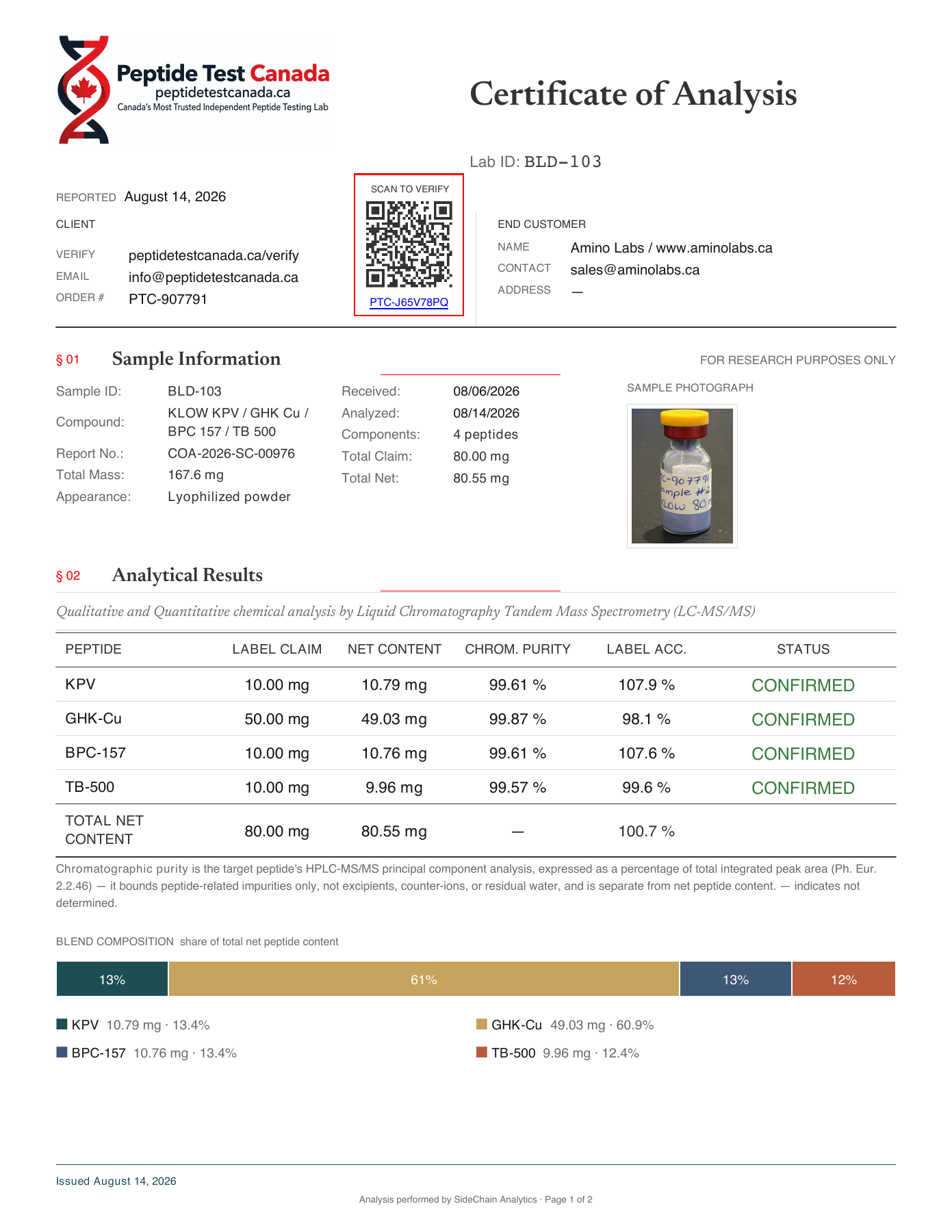
In the example, the report number is COA-2026-SC-00976, the sample ID is BLD-103 and the issue date is August 14, 2026. Its compound field names four components. These details provide a more precise reference than “KLOW tested at 99%.”
2. Verify the complete document
Use the certificate’s verification code or QR link to check the issuing service’s record. Compare the returned sample details and date with the document. Review every page: results may appear on the first page while analytical details and limitations appear later.
For this example, code PTC-J65V78PQ returned a verified record and a two-page PDF. The PDF is dated August 14, 2026, while the portal issue date is August 15, 2026; the portal does not explain that difference. The verification establishes that the record is served by the issuer’s system. It does not constitute an independent audit of the laboratory, method or sample chain of custody.
3. Keep purity, content and mass separate
| Field | What to read | Example |
|---|---|---|
| Chromatographic purity | The reported percentage for a target component under the stated analytical method. | GHK-Cu: 99.87% |
| Net peptide content | The reported quantity of a named peptide, in milligrams. | GHK-Cu: 49.03 mg |
| Total mass | A separate sample mass field; do not assume it is all peptide. | 167.6 mg total mass |
| Total net content | The certificate’s reported combined peptide amount. | 80.55 mg total net content |
The example’s purity footnote describes a peak-area measurement and excludes excipients, counterions and residual water from its scope. That is why a purity percentage cannot simply be read as the percentage of all powder weight that is peptide.
4. Read each ingredient in a blend
For a blend, check that all claimed ingredients have their own results. An acceptable-looking total can conceal differences between individual component amounts. This is especially relevant when a blend contains one large component and several smaller ones.
The KLOW report lists a 50 mg GHK-Cu claim and three 10 mg claims. The measured quantities differ from those claims in both directions. The full KLOW 80 mg results breakdown shows the individual rows and explains the small rounding difference in the displayed total.
5. Read label accuracy as a comparison
Label accuracy compares a measured amount with its stated claim. For example, 49.03 mg divided by 50.00 mg, multiplied by 100, gives 98.06%, displayed as 98.1% on the report.
This is a different calculation from chromatographic purity. A sample can have a high reported purity and still contain more or less peptide than its label states. Do not turn a label-accuracy result into a purity claim.
6. Check what was actually tested
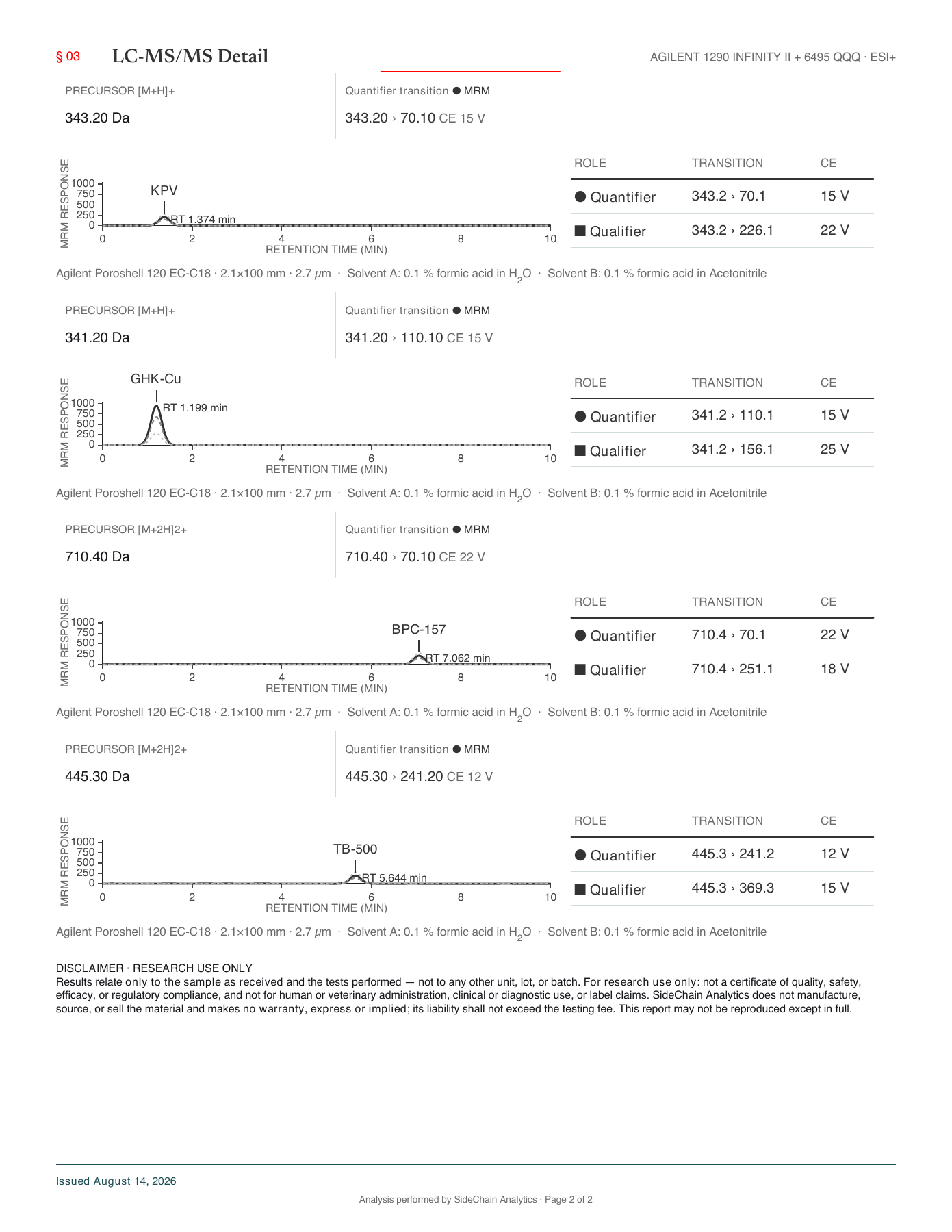
Read the method headings and the result rows together. Here, the analytical section is described as LC-MS/MS, and the second page provides component-specific retention times and monitored transitions. A graph or instrument name alone is not a result for every possible quality attribute.
If a document does not report sterility, endotoxins, residual solvents or a particular contaminant, mark that question as unanswered by that document. Likewise, a one-time analysis does not establish a storage shelf life. The retatrutide stability article explains the separate role of measurements taken over time.
7. Preserve the limits in your summary
A clear summary names the sample, gives the measured result and states its scope. For example: “Report COA-2026-SC-00976 gives 80.55 mg total net peptide content for sample BLD-103.” Avoid extending that sentence into a claim about all products bearing the same blend name.
The example certificate expressly limits its findings to the sample as received and the tests performed. It does not certify safety, efficacy or regulatory compliance. Keeping those boundaries with the numbers makes the summary more accurate and more useful.
Sample identity → complete verified report → individual quantities → purity → methods → untested questions. This sequence keeps a prominent percentage from overshadowing the rest of the evidence.
KLOW 80 mg: laboratory report
80.55 mg total net peptide content; component purities range from 99.57% to 99.87%.
Submitted sample BLD-103 · Report COA-2026-SC-00976 · PDF date August 14, 2026. These results apply to this submitted sample; match your product’s batch documentation before applying them to another vial.
Every page of the actual certificate is displayed below. Select a page to enlarge it, including its original QR code.
How to verify this report with the lab
- Scan the original QR code on page 1 with a phone camera. On the same phone, open the laboratory verification page instead.
- Enter PTC-J65V78PQ and select Verify. Check for the certificate confirmation and portal issue date August 15, 2026.
- Open the lab-hosted PDF. Match sample BLD-103, report COA-2026-SC-00976, PDF date August 14, 2026, formulation and analytical results to the pages shown here. The portal sample label is BLD-103_Blend_CoA_20260814_054957.
Date distinction: the PDF is dated August 14, 2026; the verification portal lists August 15, 2026. These are displayed separately because the portal does not explain the difference.
We checked the laboratory record and confirmed that its downloadable PDF exactly matches the supplied file. Compare the lab-hosted PDF ↗. This is document verification, not independent retesting. The report does not establish sterility, endotoxin levels, storage stability, clinical effectiveness or safety for human use, and does not validate dosing guidance.
Two-page certificate COA-2026-SC-00976, sample BLD-103, issued August 14, 2026. Read the complete laboratory certificate. This guide explains the reported fields and does not independently validate the analytical method or recommend use of the material.