
LAB REPORT EXPLAINED
These retatrutide certificates offer a clear look at two labelled vial strengths. With the original reports available to read and verify, you can explore the measured quantities and purity results side by side.
Retatrutide results at a glance
| Report field | 10 mg sample | 30 mg sample |
|---|---|---|
| Sample ID | RET-259 | RET-200 |
| Label claim | 10.00 mg | 30.00 mg |
| Net peptide content | 9.48 mg | 29.50 mg |
| Label accuracy | 94.8% | 98.3% |
| Chromatographic purity | 99.3% | 99.8% |
| PDF date | August 14, 2026 | July 31, 2026 |
The 10 mg sample measured 0.52 mg below its claim; the 30 mg sample measured 0.50 mg below its claim. The corresponding percentages differ because the nominal amounts differ. Both reports show a passing result against their stated minimum criteria of 90% label accuracy and 98% purity.
These are two separate samples analyzed on different dates. They do not establish that one vial size is consistently more accurate or purer across batches. The measured quantities should not be used to revise a personal dose.
Purity and content answer different questions
Chromatographic purity describes the target peptide’s share of the integrated analytical signal under the reported method. Net peptide content is a quantity in milligrams. Neither field should be confused with the total powder mass. The certificate’s purity definition excludes excipients, counterions and residual water from what the percentage describes.
For example, the 10 mg report lists 64.2 mg total sample mass alongside 9.48 mg net peptide content. The 30 mg report lists 107.7 mg total mass alongside 29.50 mg net content. Presenting the powder weight as the retatrutide amount would misread both reports.
Complete retatrutide COAs
Each certificate has its own verification code. Use the code belonging to the correct vial strength.
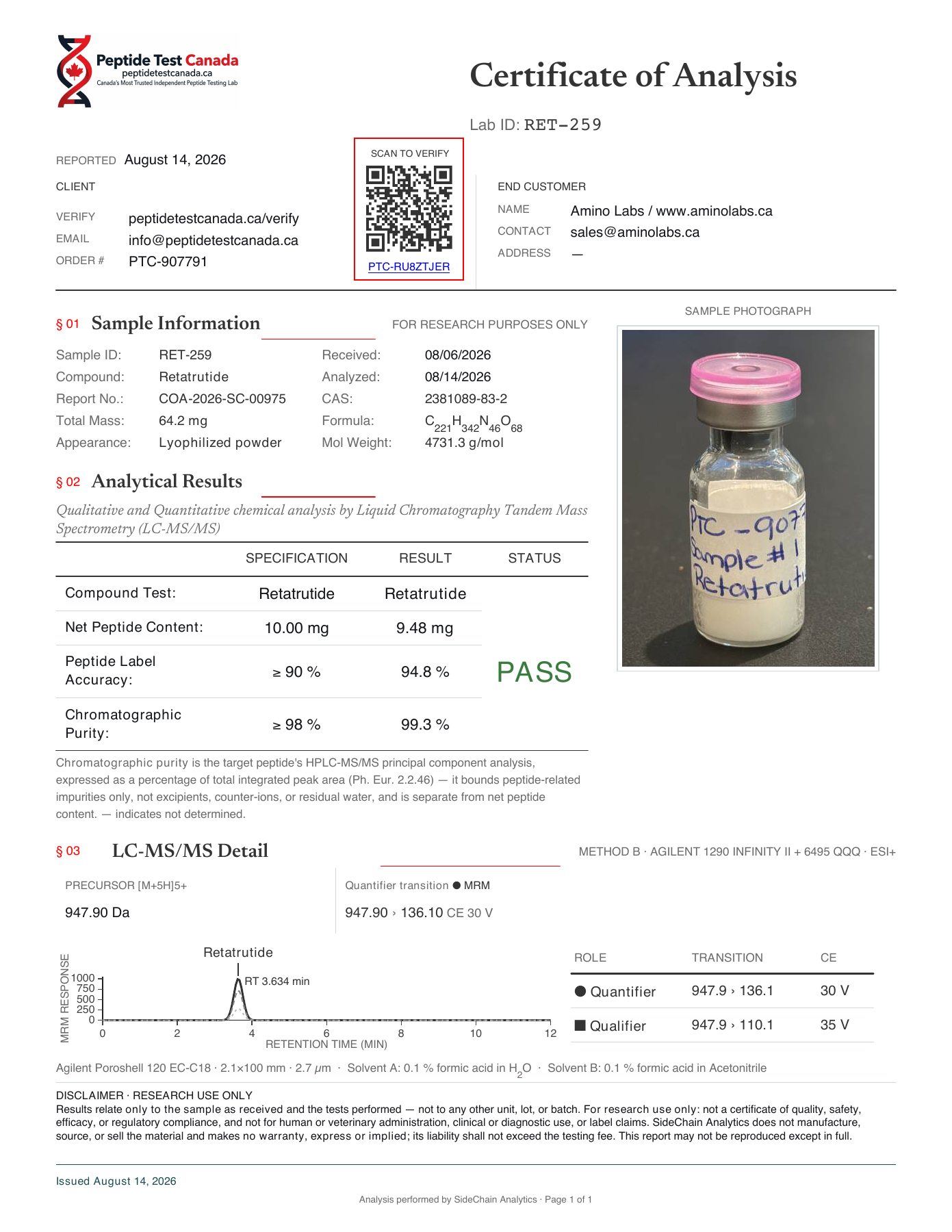
Retatrutide 10 mg: laboratory report
9.48 mg net peptide content; 99.3% chromatographic purity.
Submitted sample RET-259 · Report COA-2026-SC-00975 · PDF date August 14, 2026. These results apply to this submitted sample; match your product’s batch documentation before applying them to another vial.
Every page of the actual certificate is displayed below. Select a page to enlarge it, including its original QR code.
How to verify this report with the lab
- Scan the original QR code on page 1 with a phone camera. On the same phone, open the laboratory verification page instead.
- Enter PTC-RU8ZTJER and select Verify. Check for the certificate confirmation and portal issue date August 15, 2026.
- Open the lab-hosted PDF. Match sample RET-259, report COA-2026-SC-00975, PDF date August 14, 2026, formulation and analytical results to the pages shown here. The portal sample label is RET-259_CoA_20260814_045534.
Date distinction: the PDF is dated August 14, 2026; the verification portal lists August 15, 2026. These are displayed separately because the portal does not explain the difference.
We checked the laboratory record and confirmed that its downloadable PDF exactly matches the supplied file. Compare the lab-hosted PDF ↗. This is document verification, not independent retesting. The report does not establish sterility, endotoxin levels, storage stability, clinical effectiveness or safety for human use, and does not validate dosing guidance.
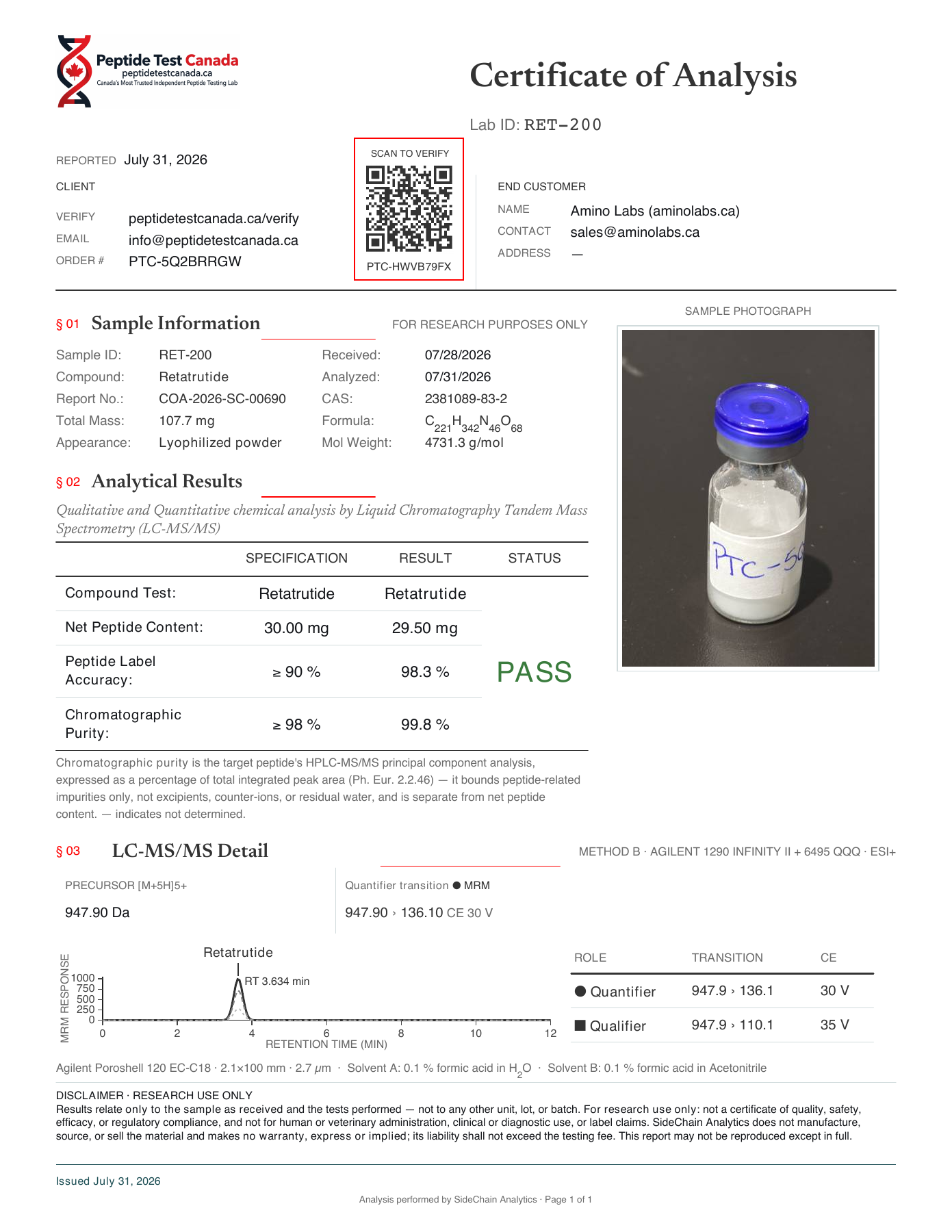
Retatrutide 30 mg: laboratory report
29.50 mg net peptide content; 99.8% chromatographic purity.
Submitted sample RET-200 · Report COA-2026-SC-00690 · PDF date July 31, 2026. These results apply to this submitted sample; match your product’s batch documentation before applying them to another vial.
Every page of the actual certificate is displayed below. Select a page to enlarge it, including its original QR code.
How to verify this report with the lab
- Scan the original QR code on page 1 with a phone camera. On the same phone, open the laboratory verification page instead.
- Enter PTC-HWVB79FX and select Verify. Check for the certificate confirmation and portal issue date July 31, 2026.
- Open the lab-hosted PDF. Match sample RET-200, report COA-2026-SC-00690, PDF date July 31, 2026, formulation and analytical results to the pages shown here.
We checked the laboratory record and confirmed that its downloadable PDF exactly matches the supplied file. Compare the lab-hosted PDF ↗. This is document verification, not independent retesting. The report does not establish sterility, endotoxin levels, storage stability, clinical effectiveness or safety for human use, and does not validate dosing guidance.
Reading the evidence in context
A certificate is a record of a particular submitted sample. It does not establish that every vial or every later batch has the same composition. Compare the sample identification and formulation with the accompanying batch documentation, and retain the complete report rather than a cropped purity claim.
The reports describe LC-MS/MS analysis. They do not include a sterility result, an endotoxin result, a storage study or a clinical assessment. A confirmed verification code establishes that a document is in the issuing service’s records; it does not independently validate the analytical methods or retest the material.
For a fuller explanation of the fields, see how to read a peptide COA. Browse the research blog for more report reviews.