
LL-37 (5 mg Vial) Dosage Protocol
Contents
Quickstart Highlights
LL-37 (also known as CAP-18) is a 37-amino-acid cationic antimicrobial peptide derived from the C-terminal of human cathelicidin (hCAP18)[1]. It is the only known human cathelicidin, exhibiting broad-spectrum antibacterial activity and immune-modulating properties[2][3]. This educational protocol presents a once-daily subcutaneous approach using a practical dilution for clear insulin-syringe measurements.
- Reconstitute: Add 3.0 mL bacteriostatic water → ~1.67 mg/mL concentration.
- Typical daily range: 100–400 µg once daily (gradual titration).
- Easy measuring: At 1.67 mg/mL, 1 unit = 0.01 mL ≈ 16.7 µg on a U-100 insulin syringe.
- Storage: Lyophilized: freeze at −20 °C (−4 °F); after reconstitution, refrigerate at 2–8 °C (35.6–46.4 °F) for up to 4 weeks; avoid freeze–thaw cycles.
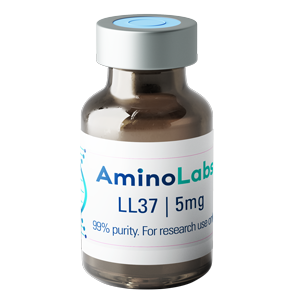
Dosing & Reconstitution Guide
Standard / Gradual Approach (3 mL = ~1.67 mg/mL)
| Week | Daily Dose (µg) | Units (per injection) (mL) |
|---|---|---|
| Week 1 | 50 µg | 3 units (0.03 mL) |
| Week 2 | 100 µg | 6 units (0.06 mL) |
| Week 3 | 150 µg | 9 units (0.09 mL) |
| Week 4 | 200 µg | 12 units (0.12 mL) |
| Week 5 | 250 µg | 15 units (0.15 mL) |
| Week 6 | 300 µg | 18 units (0.18 mL) |
| Week 7 | 350 µg | 21 units (0.21 mL) |
| Week 8 | 400 µg | 24 units (0.24 mL) |
Frequency: Inject once daily subcutaneously. Some protocols use a 5-days-on, 2-days-off schedule. For ≤10-unit (≤0.10 mL) administrations during early titration, consider 30- or 50-unit insulin syringes for improved readability.
Reconstitution Steps
- Draw 3.0 mL bacteriostatic water with a sterile syringe.
- Inject slowly down the vial wall; avoid foaming.
- Gently swirl/roll until dissolved (do not shake).
- Label and refrigerate at 2–8 °C (35.6–46.4 °F), protected from light.
Important: This guide is for educational purposes only and is not medical advice. For research use only. Not for human consumption.
Supplies Needed
Plan based on an 8–16 week daily protocol with gradual titration.
- Peptide Vials (LL-37, 5 mg each):
- 8 weeks ≈ 3 vials
- 12 weeks ≈ 5 vials
- 16 weeks ≈ 7 vials
- Insulin Syringes (U-100):
- Per week: 7 syringes (1/day)
- 8 weeks: 56 syringes
- 12 weeks: 84 syringes
- 16 weeks: 112 syringes
- Bacteriostatic Water (10 mL bottles): Use ~3.0 mL per vial for reconstitution.
- 8 weeks (3 vials): 9 mL → 1 × 10 mL bottle
- 12 weeks (5 vials): 15 mL → 2 × 10 mL bottles
- 16 weeks (7 vials): 21 mL → 3 × 10 mL bottles
- Alcohol Swabs: One for the vial stopper + one for the injection site each day.
- Per week: 14 swabs (2/day)
- 8 weeks: 112 swabs → recommend 2 × 100-count boxes
- 12 weeks: 168 swabs → recommend 2 × 100-count boxes
- 16 weeks: 224 swabs → recommend 3 × 100-count boxes
![insulin[1]](https://peptidedosing.ca/wp-content/uploads/2026/01/insulin1-178x178.webp "insulin[1]")
![Bacteriostatic-Water-Bottle[1]](https://peptidedosing.ca/wp-content/uploads/2026/01/Bacteriostatic-Water-Bottle1-178x178.webp "Bacteriostatic-Water-Bottle[1]")
![EasyTouch_Alcohol_Pads[1]](https://peptidedosing.ca/wp-content/uploads/2026/01/EasyTouch_Alcohol_Pads1-178x178.avif "EasyTouch_Alcohol_Pads[1]")
Protocol Overview
Concise summary of the once-daily regimen.
- Goal: Support antimicrobial defense and wound-healing processes[4][5].
- Schedule: Daily subcutaneous injections for 8–12 weeks (extend to 16 weeks if desired).
- Dose Range: 50–400 µg daily with gradual titration.
- Reconstitution: 3.0 mL per 5 mg vial (~1.67 mg/mL) for accurate unit measurements.
- Storage: Lyophilized frozen; reconstituted refrigerated; avoid repeated freeze–thaw.
Dosing Protocol
Suggested daily titration approach.
- Start: 50–100 µg daily; increase by ~50 µg each week as tolerated.
- Target: 200–400 µg daily by Weeks 4–8.
- Frequency: Once per day (subcutaneous); optional 5-on/2-off schedule.
- Cycle Length: 8–12 weeks; optional extension to 16 weeks.
- Timing: Any consistent time; rotate injection sites.
Storage Instructions
Proper storage preserves peptide quality[6][7].
- Lyophilized: Store at −20 °C (−4 °F) in dry, dark conditions; stable ~24 months.
- Reconstituted: Refrigerate at 2–8 °C (35.6–46.4 °F) for up to 4 weeks; frozen at −20 °C (−4 °F) for up to 6 months.
- Allow vials to reach room temperature before opening to reduce condensation uptake.
Important Notes
Practical considerations for consistency and safety.
- Use new sterile insulin syringes; dispose in a sharps container[8].
- Rotate injection sites (abdomen, thighs, upper arms) to reduce local irritation[9].
- Inject slowly; wait a few seconds before withdrawing the needle.
- Document daily dose and site rotation to maintain consistency.
- Early-phase doses (≤10 units) benefit from 30- or 50-unit syringes for precision.
How This Works
LL-37 exerts both direct and indirect antimicrobial effects. Its amphipathic, cationic α-helical structure (net +6 charge) allows it to preferentially bind and disrupt negatively charged microbial membranes[2]. Beyond direct killing, LL-37 modulates host immunity: in murine sepsis models, it induced neutrophils to release microvesicles rich in antimicrobial proteins, lowering bacterial burden and improving survival[3]. LL-37 can also bind bacterial lipopolysaccharide (LPS) and block its interaction with CD14/TLR4, reducing endotoxin-triggered TNF release and neutrophil apoptosis[2]. These combined mechanisms help explain its potential in infection control and tissue-repair contexts.
Potential Benefits & Side Effects
Observations from preclinical and clinical literature.
- In chronic venous leg ulcers (which often lack endogenous LL-37), topical treatment with synthetic LL-37 significantly accelerated healing rates compared to placebo[4].
- In diabetic foot ulcer trials, LL-37 cream improved granulation tissue formation and wound closure[5].
- Broad-spectrum antimicrobial action helps clear infections; in experimental sepsis models, LL-37 treatment reduced bacterial loads and mortality[3].
- Generally well tolerated; occasional mild injection-site reactions (redness, itch) may occur with subcutaneous administration.
Lifestyle Factors
Complementary strategies for best outcomes.
- Optimize vitamin D status, as vitamin D upregulates endogenous cathelicidin/LL-37 expression[10].
- Support wound healing with adequate protein intake and micronutrient sufficiency (zinc, vitamin C).
- Maintain proper wound hygiene and dressing protocols if using for tissue-repair goals.
- Prioritize sleep and stress management to support immune function and recovery.
Injection Technique
General subcutaneous guidance from clinical best-practice resources[11].
- Clean the vial stopper and skin with alcohol; allow to dry.
- Pinch a skinfold; insert the needle at 45–90° into subcutaneous tissue[9][12].
- Do not aspirate for subcutaneous injections; inject slowly and steadily[12].
- Rotate sites systematically (abdomen, thighs, upper arms) and move at least 2–3 cm from the previous site[9].
- Use aseptic technique; always use a new sterile needle and syringe for each injection[8].
Recommended Source
Why Amino Labs?
- Third-party tested: Each batch includes Certificate of Analysis (COA) verifying purity and composition.
- Consistent quality: ISO-aligned manufacturing and handling standards ensure reliable product integrity.
- Cold-chain integrity: Temperature-controlled shipping and storage throughout fulfillment process.
- Research-grade purity: Suitable for educational and research applications requiring high-quality peptides.
Note: Product availability and specifications subject to change. Verify current product details on supplier website.
Important Note
This content is intended for therapeutic educational purposes only and does not constitute medical advice, diagnosis, or treatment.
References
— Little peptide, big effects: the role of LL-37 in inflammation and autoimmune disease
— Antimicrobial peptide LL-37 ameliorates a murine sepsis model via microvesicle release from neutrophils
— Evaluation of LL-37 in healing of hard-to-heal venous leg ulcers: a multicentric prospective RCT
— Efficacy of LL-37 cream in enhancing healing of diabetic foot ulcer: a randomized double-blind controlled trial
— Handling and storage guidelines for peptides
— One needle, one syringe, only one time (injection safety)
— How to give a subcutaneous injection (site selection, rotation)
— Vitamin D and the antimicrobial peptide cathelicidin (LL-37)
— Vaccine administration: subcutaneous injection (angle/site; no aspiration)
— Best practices for injection (asepsis, preparation, and administration)
— Subcutaneous drug injection review: pharmacologic considerations