
AOD-9604 (5mg Vial) Dosage Protocol
Contents
Quickstart Highlights
AOD-9604 dosage protocols leverage this synthetic 16‑amino‑acid fragment (Tyr‑hGH 177–191) to support lipolysis (fat breakdown) and inhibit lipogenesis (fat storage) without elevating IGF‑1 levels or causing insulin resistance[1][2]. Clinical trials have demonstrated that AOD‑9604 exhibits a placebo‑like safety profile in obese adults, making it a well‑tolerated option for metabolic support[3]. This educational protocol outlines a once‑daily subcutaneous approach using a practical dilution for clear insulin‑syringe measurements.
- Reconstitute: Add 3.0 mL bacteriostatic water → ~1.667 mg/mL (1667 mcg/mL) concentration.
- Typical daily range: 300–500 mcg once daily (gradual titration).
- Easy measuring: At 1.667 mg/mL, 1 unit = 0.01 mL ≈ 16.67 mcg on a U‑100 insulin syringe.
- Storage: Lyophilized: freeze at −20 °C (−4 °F); after reconstitution, refrigerate at 2–8 °C (35.6–46.4 °F); avoid freeze–thaw cycles.
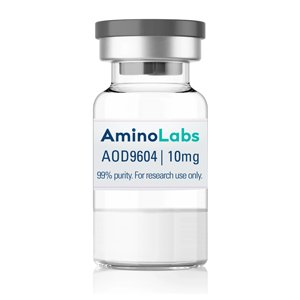
Dosing & Reconstitution Guide
Standard / Gradual Approach (3 mL = ~1.667 mg/mL)
| Week | Daily Dose (mcg) | Units (per injection) (mL) |
|---|---|---|
| Weeks 1–4 | 300 mcg | 18 units (0.18 mL) |
| Weeks 5–12 | 500 mcg | 30 units (0.30 mL) |
Frequency: Inject once daily subcutaneously (typically in the morning on an empty stomach). This schedule uses the largest practical dilution (3.0 mL) to keep per‑injection units ≥10 for better accuracy. Rotate injection sites (abdomen, thighs, upper arms) to minimize local irritation.
Reconstitution Steps
- Draw 3.0 mL bacteriostatic water with a sterile syringe.
- Inject slowly down the vial wall; avoid foaming.
- Gently swirl/roll until dissolved (do not shake).
- Label and refrigerate at 2–8 °C (35.6–46.4 °F), protected from light.
Important: This guide is for educational purposes only and is not medical advice. For research use only. Not for human consumption.
Supplies Needed
Plan based on an 8–12 week daily protocol with gradual titration (300 mcg Weeks 1–4, 500 mcg Weeks 5+).
- Peptide Vials (AOD-9604, 5 mg each):
- 8 weeks ≈ 5 vials
- 12 weeks ≈ 8 vials
- 16 weeks ≈ 11 vials
- Insulin Syringes (U‑100):
- Per week: 7 syringes (1/day)
- 8 weeks: 56 syringes
- 12 weeks: 84 syringes
- 16 weeks: 112 syringes
- Bacteriostatic Water (10 mL bottles): Use 3.0 mL per vial for reconstitution.
- 8 weeks (5 vials): 15 mL → 2 × 10 mL bottles
- 12 weeks (8 vials): 24 mL → 3 × 10 mL bottles
- 16 weeks (11 vials): 33 mL → 4 × 10 mL bottles
- Alcohol Swabs: One for the vial stopper + one for the injection site each day.
- Per week: 14 swabs (2/day)
- 8 weeks: 112 swabs → recommend 2 × 100‑count boxes
- 12 weeks: 168 swabs → recommend 2 × 100‑count boxes
- 16 weeks: 224 swabs → recommend 3 × 100‑count boxes
![insulin[1]](https://peptidedosing.ca/wp-content/uploads/2026/01/insulin1-178x178.webp "insulin[1]")
![Bacteriostatic-Water-Bottle[1]](https://peptidedosing.ca/wp-content/uploads/2026/01/Bacteriostatic-Water-Bottle1-178x178.webp "Bacteriostatic-Water-Bottle[1]")
![EasyTouch_Alcohol_Pads[1]](https://peptidedosing.ca/wp-content/uploads/2026/01/EasyTouch_Alcohol_Pads1-178x178.avif "EasyTouch_Alcohol_Pads[1]")
Protocol Overview
Concise summary of the once‑daily regimen.
- Goal: Support reduction of fat mass and enhance fat oxidation over time[1][4].
- Schedule: Daily subcutaneous injections for 8–12 weeks (extend to 16 weeks if desired).
- Dose Range: 300–500 mcg daily with gradual titration.
- Reconstitution: 3.0 mL per 5 mg vial (~1.667 mg/mL) for accurate unit measurements.
- Storage: Lyophilized frozen; reconstituted refrigerated; avoid repeated freeze–thaw.
Dosing Protocol
Suggested daily titration approach.
- Start: 300 mcg daily for Weeks 1–4; increase to 500 mcg for Weeks 5–12 as tolerated.
- Target: 500 mcg daily by Week 5 and maintain through cycle completion.
- Frequency: Once per day (subcutaneous).
- Cycle Length: 8–12 weeks; optional extension to 16 weeks.
- Timing: Morning administration (fasted) is common; rotate injection sites.
Storage Instructions
Proper storage preserves peptide quality.
Important Notes
Practical considerations for consistency and safety.
- Use new sterile insulin syringes (U‑100, 29–31 gauge); dispose in a sharps container[7].
- Rotate injection sites (abdomen, thighs, upper arms) to reduce local irritation and prevent lipohypertrophy[8].
- Inject slowly; wait a few seconds before withdrawing the needle.
- Each 2 mg vial provides approximately 4 days of dosing at 500 mcg/day or 6–7 days at 300 mcg/day.
How This Works
AOD‑9604 is a modified C‑terminal fragment of human growth hormone that retains the lipolytic (fat‑reducing) domain without the growth‑promoting effects[1]. It binds to adipose tissue and triggers breakdown of stored fat while blocking new fat storage (re‑esterification) in adipocytes[4]. At the molecular level, chronic AOD‑9604 administration upregulates β3‑adrenergic receptors in fat tissue, reversing obesity‑related suppression of these fat‑burning receptors[9]. Unlike full‑length hGH, AOD‑9604 does not meaningfully elevate IGF‑1 levels or worsen glucose tolerance, making its tolerability indistinguishable from placebo in human trials[2][3].
Potential Benefits & Side Effects
Observations from preclinical and clinical literature.
- Supports reductions in fat mass and increases in fat oxidation over time; clinical trials showed modest but statistically significant weight loss (approximately 2.6 kg vs. 0.8 kg placebo over 12 weeks at 1 mg/day)[10].
- Preferential loss of abdominal fat observed, resembling the pattern seen with low‑dose hGH therapy[10].
- Does not meaningfully raise IGF‑1 and shows a placebo‑like safety profile in human studies; no anti‑AOD9604 antibodies detected[2][3].
- Emerging regenerative potential: preclinical studies suggest possible cartilage repair and bone health benefits[11][12].
- Generally well tolerated; occasional mild injection‑site reactions (redness/itch) may occur with subcutaneous administration.
Lifestyle Factors
Complementary strategies for best outcomes.
- Pair with a hypocaloric, protein‑forward diet tailored to energy needs; AOD‑9604 is best viewed as a supportive aid to fat loss rather than a stand‑alone solution[10].
- Combine resistance training and aerobic activity to reinforce metabolic adaptations.
- Prioritize sleep and stress management to support adherence and recovery.
Injection Technique
General subcutaneous guidance from clinical best‑practice resources[7].
- Clean the vial stopper and skin with alcohol; allow to dry completely[8].
- Pinch a skinfold; insert the needle at 90° (or 45° if very little subcutaneous fat) into subcutaneous tissue[7].
- Do not aspirate for subcutaneous injections; inject slowly and steadily[13].
- Rotate sites systematically (abdomen at least 2 inches from navel, thighs, upper arms) to avoid lipohypertrophy[8].
Recommended Source
We recommend Amino Labs for high-purity Retatrutide (5 mg vials).
Why Amino Labs?
- Third-party tested: Each batch includes Certificate of Analysis (COA) verifying purity and composition.
- Consistent quality: ISO-aligned manufacturing and handling standards ensure reliable product integrity.
- Cold-chain integrity: Temperature-controlled shipping and storage throughout fulfillment process.
- Research-grade purity: Suitable for educational and research applications requiring high-quality peptides.
Note: Product availability and specifications subject to change. Verify current product details on supplier website.
Important Note
This content is intended for therapeutic educational purposes only and does not constitute medical advice, diagnosis, or treatment.
References
— Safety and metabolism of AOD9604 as a nutraceutical ingredient; mechanism of action and metabolic studies
— Safety and tolerability of AOD9604 in humans; no IGF‑1 increase; placebo‑like safety profile
— AOD‑9604 bulk drug substance meeting memorandum; regulatory and safety overview
— Effects of hGH and AOD9604 on lipid metabolism in obese mice; β‑adrenergic pathway mechanisms
— Handling and storage guidelines for peptides; lyophilized stability recommendations
— Peptide stability and shelf life; reconstituted solution storage guidelines
— Subcutaneous injection patient instructions; technique and site guidance
— How to administer a subcutaneous injection; site rotation and hygiene
— Chronic AOD9604 treatment in obese and β3‑AR knockout mice; receptor upregulation
— Drug treatment of the overweight patient; AOD‑9604 RCT summary and clinical efficacy
— Effect of intra‑articular AOD9604 with hyaluronic acid in rabbit osteoarthritis model
— AOD9604 drug summary; mechanism of action, bone and metabolic effects
— Vaccine administration: subcutaneous route; no aspiration required
— BPC-157 (5 mg) product page (quality and batch documentation)