Quickstart Highlights
Melatonin is the indoleamine hormone the pineal gland secretes in darkness to signal night through MT1 and MT2 receptors in the suprachiasmatic nucleus. It is widely used orally for sleep-onset latency, circadian phase shifting and jet lag, and studied at high intravenous doses as an antioxidant in perioperative research. It is not a peptide, and no human subcutaneous or intramuscular dosing convention exists: every source reviewed either omits injection or states that no guidelines exist. This reference page therefore presents no schedule; it summarizes the oral reference doses, the single-dose IV pharmacokinetic data and the veterinary implant context so that the 10 mg vial can be read against the evidence.
- Identity: Melatonin (N-acetyl-5-methoxytryptamine) is an indoleamine hormone, a small molecule of about 232 Da secreted by the pineal gland; it is not a peptide and is unusual as an injectable research product.
- Dosing status: No established dosing schedule. No human subcutaneous or intramuscular dosing study, trial, label or reputable dosing-site protocol exists; the only human parenteral data are single-dose IV pharmacokinetic studies.
- Evidence: Human IV pharmacokinetic studies (single doses of 10 mg and 100 mg, n=12) and oral RCTs; animal data only for subcutaneous injection, and veterinary SC use is a solid implant. Confidence is low for any injectable use because no human SC or IM dosing exists.
- Storage: Lyophilized vial refrigerated at 2–8 °C (35.6–46.4 °F) or frozen at −20 °C (−4 °F), protected from light; no reconstitution or in-use period is documented.
Evidence Summary
Oral reference versus injectable
| Reference | Amount | Context |
|---|---|---|
| Oral, typical adult | 3–5 mg nightly (range 0.1–10 mg) | GoodRx dosage summary; start at 1–2 mg; above 8 mg not recommended |
| IV bolus, pharmacokinetic | 10 mg and 100 mg single dose | Andersen 2016, n=12 male volunteers; no adverse effects reported |
| Oral versus IV, same dose | 10 mg oral vs 10 mg IV | Andersen 2016, n=12; oral bioavailability median 2.5% |
| Subcutaneous, human | No studies identified | Zetner, Andersen and Rosenberg 2016 systematic review |
| Subcutaneous implant, veterinary | 8–18 mg solid implant | Dermatonin (dogs, cats) and Ovimel (sheep); releases for 3–4 months |
Why no schedule is given: Every source reviewed either omits injection or states that no guidelines exist for subcutaneous or intramuscular melatonin in humans. The only human parenteral data are single-dose intravenous pharmacokinetic studies, which characterize absorption and half-life but were never designed to set a dose, frequency or course. Veterinary subcutaneous products are solid implants rather than aqueous injections. Melatonin is also only sparingly soluble in water, so reconstituting a lyophilized 10 mg vial in bacteriostatic water is itself unvalidated. Presenting a schedule would mean inventing one.
Important: This guide is for educational purposes only and is not medical advice. For research use only. Not for human consumption.
Reference Overview
Concise summary of the reference-only status.
- Goal: Provide context for a 10 mg melatonin vial against the oral and intravenous evidence; no injectable goal is defined because no injectable protocol exists.
- Schedule: None presented; oral melatonin is taken once nightly, 1–2 hours before bedtime, and IV research doses were single daytime boluses in pharmacokinetic studies.
- Dose Range: Oral reference 3–5 mg nightly for most adults (range 0.1–10 mg, starting at 1–2 mg); IV research single doses of 10 mg and 100 mg; no subcutaneous or intramuscular dose range exists.
- Evidence: Human IV pharmacokinetic studies (single doses of 10 mg and 100 mg, n=12) and oral RCTs; animal data only for subcutaneous injection, and veterinary SC use is a solid implant. Confidence is low for any injectable use because no human SC or IM dosing exists.
Research Dosing Context
What the literature and sources contain about melatonin by route, and how it relates to a 10 mg injectable vial. No dose is recommended.
- Oral reference: Most adults use 3–5 mg nightly (range 0.1–10 mg), starting at 1–2 mg, taken 1–2 hours before bedtime; doses above 8 mg are not recommended because of side-effect risk.
- Oral bioavailability: Reported as about 2.5% in one crossover study (Andersen 2016) and 9–33%, about 15%, in a systematic review (Harpsoe 2015); either way, 10 mg delivered parenterally produces roughly 7–40 times the systemic exposure of 10 mg oral.
- IV research: Single 10 mg and 100 mg IV boluses in 12 male volunteers produced peak plasma levels of about 221,500 and 1,251,500 pg/mL with a half-life of 42–46 minutes and no sedation or adverse effects; a 10 mg IV dose gave roughly 100 times the oral peak.
- Subcutaneous and intramuscular: A systematic review of alternative routes (Zetner 2016) identified no human subcutaneous melatonin studies and no documented advantage for injection; the only SC data are a 1986 hamster pharmacokinetic study.
- Veterinary context: Subcutaneous use in animals is a solid slow-release implant (8–18 mg in dogs, cats and sheep) that releases melatonin for 3–4 months; it is not an aqueous injection and does not transfer to human dosing.
- Vial relation: The 10 mg vial equals the highest oral dose and the lower of the two IV research doses. Because the half-life is about 40–55 minutes, any single injection would produce a brief peak rather than sustained levels, and no source gives a reconstitution volume.
Storage Instructions
Proper storage preserves product quality and efficacy.
- Lyophilized (powder): No dosing source documents storage; general practice is refrigeration at 2–8 °C (35.6–46.4 °F) or freezing at −20 °C (−4 °F), protected from light, since melatonin is light-sensitive.
- Reconstituted (solution): No in-use period is documented. Melatonin is sparingly water-soluble, and clinical IV preparations use ethanol or propylene-glycol co-solvents or cyclodextrin, so a bacteriostatic-water reconstitution of a 10 mg vial is unvalidated and may not dissolve cleanly.
- Allow vials to reach room temperature before opening to minimize condensation uptake.
- Keep the vial in its carton or an opaque sleeve; light exposure degrades melatonin.
Important Notes
Practical considerations for consistency and safety.
- No injectable protocol: This page gives no dose, frequency or course because no human subcutaneous or intramuscular melatonin dosing exists in any trial, label or reputable dosing reference.
- Regulatory status: Oral melatonin is a licensed natural health product in Canada (up to 10 mg) and a dietary supplement in the US; injectable melatonin is not approved anywhere for human use. Not approved by Health Canada or the FDA as an injectable; research use only.
- Evidence caveat: The human parenteral evidence is a pair of single-dose IV pharmacokinetic studies in 12 volunteers; tolerance of a 100 mg IV bolus in that setting does not establish the safety of repeated injection by any route.
- Exposure gap: Oral bioavailability is roughly 2.5–15%, so 10 mg given intravenously delivers about 7–40 times the systemic exposure of the same oral dose; oral guidance already advises against exceeding 8 mg.
- Solubility: Melatonin is only sparingly soluble in water; no source gives a reconstitution volume, and a bacteriostatic-water preparation is unvalidated for dissolution, stability and local tolerability.
- Interactions: The oral literature lists interactions with sedatives, anticoagulants, immunosuppressants and blood-pressure medicines; these apply to any route.
- Not a peptide: Melatonin is an indoleamine hormone and its presence in a peptide catalog is a listing convention; the standard human route is oral, 1–2 hours before bedtime.
How This Works
Melatonin is an indoleamine secreted by the pineal gland in darkness. It acts on MT1 and MT2 G-protein-coupled receptors in the suprachiasmatic nucleus to signal night, lowering alertness and shifting circadian phase, which is the basis for its oral use in sleep-onset difficulty, jet lag and shift work. At pharmacological concentrations it also acts as a direct free-radical scavenger and up-regulates antioxidant enzymes, the rationale for high-dose IV research in perioperative settings. Its pharmacokinetics explain why injection has not been developed as a human route: the half-life is about 40–55 minutes by either oral or IV administration, so any single injection produces a brief, very high peak rather than sustained levels, and oral dosing already achieves the receptor-level signal needed for circadian effects. Oral bioavailability is low, about 2.5–15%, because of first-pass metabolism to 6-hydroxymelatonin, which is why an intravenous 10 mg dose yielded roughly 100 times the oral peak concentration.
Potential Benefits & Side Effects
Observations from oral clinical evidence, IV research and veterinary use; none applies to human injection.
Potential Benefits:
- Reduced sleep-onset latency and circadian phase shifting (oral evidence).
- Jet lag and shift-work adaptation (oral evidence).
- Antioxidant and anti-inflammatory effects studied at high IV doses in perioperative research (investigational).
- Coat regrowth and seasonal breeding control in animals through a subcutaneous implant (veterinary use only).
Potential Side Effects:
- Drowsiness, dizziness, headache, nausea and vomiting at high oral doses.
- No sedation or adverse effects reported after 10–100 mg IV bolus in healthy volunteers, in a single small study.
- Unknown local tolerability of subcutaneous or intramuscular aqueous injection in humans; solvent or co-solvent irritation is possible.
- Interactions with sedatives, anticoagulants, immunosuppressants and blood-pressure drugs in the oral literature.
Lifestyle Factors
Practices that address sleep and circadian goals without an injectable protocol.
- Oral melatonin at the lowest effective dose (starting at 1–2 mg), 1–2 hours before bedtime, is the reference approach for short-term use.
- Anchor the circadian clock with a fixed wake time and bright light within an hour of waking.
- Dim lights and limit screens in the 1–2 hours before bed; evening light suppresses melatonin secretion.
- Keep the bedroom dark, cool and quiet; for jet lag, shift the schedule toward the destination time zone before travel.
- Limit caffeine after midday and alcohol in the evening, both of which fragment sleep.
- Review persistent insomnia with a clinician rather than escalating dose; oral guidance does not support long-term use for chronic sleep problems.
Recommended Source
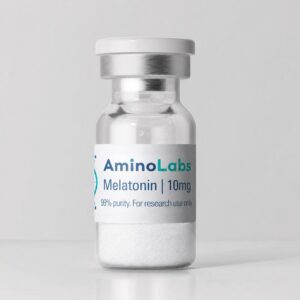
We recommend Amino Labs for high-purity Melatonin (10 mg vials).
Why Amino Labs?
- Third-party tested: Each batch includes Certificate of Analysis (COA) verifying purity and composition.
- Consistent quality: ISO-aligned manufacturing and handling standards ensure reliable product integrity.
- Cold-chain integrity: Temperature-controlled shipping and storage throughout fulfillment process.
- Research-grade purity: Suitable for educational and research applications requiring high-quality research compounds.
Note: Product availability and specifications subject to change. Verify current product details on supplier website.
Important Note
This content is intended for therapeutic educational purposes only and does not constitute medical advice, diagnosis, or treatment.