Quickstart Highlights
ACE-031 (ramatercept) is a soluble decoy receptor: the extracellular domain of activin receptor type IIB fused to a human IgG1 Fc region, a recombinant protein of about 77 kDa rather than a small peptide. It binds myostatin, activins and GDF11 before they reach muscle and was studied by Acceleron in a Phase 1 trial in healthy women and a Phase 2 trial in Duchenne muscular dystrophy, which was terminated for vascular safety signals. This page presents no dosing schedule. It summarizes the clinical doses, explains why they do not translate to a 1 mg research vial, and records the single research-market figure that exists, as context only.
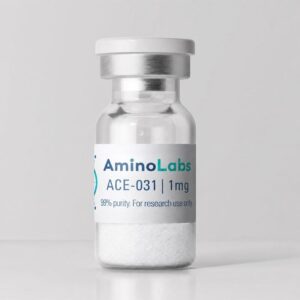
- Identity: A ~77 kDa recombinant ActRIIB-IgG1 Fc fusion protein (a biologic), not a small peptide; listed here as a 1 mg lyophilized vial.
- Dosing status: No established dosing schedule. Clinical doses ranged from 0.02 to 3 mg/kg (1.4–210 mg per dose for a 70 kg adult); the doses that produced effects or adverse events were 0.5–3 mg/kg, which is 35–210 mg per dose, or 35 to 210 times the entire 1 mg vial. No human data exist at research-market amounts.
- Evidence: Human RCT evidence of high quality at clinical doses (Phase 1, n=48; Phase 2 in DMD, terminated for safety in 2011 and discontinued in 2013), but zero evidence at sub-milligram doses, so confidence in any research-market figure is low.
- Storage: Lyophilized at −20 °C (−4 °F) or 2–8 °C (35.6–46.4 °F) depending on source; avoid freeze–thaw and shaking (protein aggregation); no validated beyond-use date after reconstitution.
Evidence Summary
Clinical dose scale versus vial size
| Reference | Amount | Context |
|---|---|---|
| Phase 1 single dose (healthy postmenopausal women) | 0.02–3 mg/kg SC, single dose | Attie 2013, n=48, double-blind; at 3 mg/kg lean mass +3.3% and thigh muscle volume +5.1% at day 29 |
| Phase 2 DMD, low arm | 0.5 mg/kg SC every 4 weeks for 12 weeks | NCT01099761; Campbell 2017; dosing stopped after the second regimen |
| Phase 2 DMD, high arm | 1.0 mg/kg SC every 2 weeks for 12 weeks | NCT01099761; terminated for epistaxis and telangiectasias |
| Effective clinical doses scaled to a 70 kg adult | 35–210 mg per dose (0.5–3 mg/kg) | Equivalent to 35–210 of the 1 mg vials; no effect or adverse event has been reported at sub-milligram amounts |
| Research-market convention (one site’s calculator) | 500 mcg SC twice weekly (1 mg/week) for up to 12 weeks | peptideprotocolwiki calculator only; no rationale given, contradicted by the same site’s dosing page |
Why no schedule is given: Every human dose of ACE-031 that produced an effect, or an adverse event, was measured in milligrams per kilogram and given every two to four weeks on the strength of a 10–15 day half-life. A 1 mg vial is roughly 0.5% of a single 3 mg/kg clinical dose for a 70 kg adult. The only sub-milligram figure in circulation, 500 mcg twice weekly, comes from one calculator with no rationale and is contradicted by the same site’s dosing page. Publishing a schedule would give an unvalidated number the authority of a protocol, so this page records the evidence and stops.
Important: This guide is for educational purposes only and is not medical advice. For research use only. Not for human consumption.
Reference Overview
Concise summary of the clinical record; this is a reference, not a regimen.
- Goal: The clinical aim was to increase lean muscle mass by blocking myostatin and activin signaling at the ActRIIB receptor.
- Schedule: No schedule is presented. Clinical trials dosed subcutaneously once every 2–4 weeks for up to 12 weeks; the program was halted in 2011.
- Dose Range: Clinical: 0.02–3 mg/kg single dose (Phase 1) and 0.5 mg/kg every 4 weeks or 1.0 mg/kg every 2 weeks (Phase 2); no validated dose exists at the 1 mg vial scale.
- Evidence: Human RCT evidence of high quality at clinical doses (Phase 1, n=48; Phase 2 in DMD, terminated for safety in 2011 and discontinued in 2013), but zero evidence at sub-milligram doses, so confidence in any research-market figure is low.
Research Dosing Context
What the literature and dosing sources contain, and how it relates to a 1 mg vial; no dose is recommended.
- Phase 1 (Attie 2013): Single ascending subcutaneous doses of 0.02, 0.05, 0.1, 0.3, 1.0 and 3.0 mg/kg in 48 healthy postmenopausal women; exposure was linear with dose and the half-life was 10–15 days.
- Phase 2 (Campbell 2017, NCT01099761): 0.5 mg/kg every 4 weeks or 1.0 mg/kg every 2 weeks for 12 weeks in boys with Duchenne muscular dystrophy; higher planned cohorts were never dosed.
- Scale versus the vial: For a 70 kg adult the doses that produced effects or adverse events were 35–210 mg (0.5–3 mg/kg), so one 1 mg vial is about 0.5% of a single 3 mg/kg dose; the lowest Phase 1 cohort (0.02 mg/kg, about 1.4 mg) showed no effect.
- Research-market figure: One site’s calculator lists 500 mcg subcutaneously twice weekly (1 mg/week, one vial per week) for up to 12 weeks. No other source offers a figure, no rationale is given, and this page does not present it as a schedule or convert it to syringe units.
- Frequency in trials: Every 2–4 weeks, matched to the long half-life; the twice-weekly research-market figure has no pharmacokinetic basis.
- Diluent: Sources disagree: one says sterile water only and use immediately, another uses bacteriostatic water at 5 mg/mL. Fc-fusion proteins are sensitive to agitation, so swirl and never shake.
- Vial size: The Amino Labs listing says 1 mg while the product URL says 10 mg; confirm the label before any calculation.
Storage Instructions
Proper storage preserves product quality and efficacy.
- Lyophilized: −20 °C (−4 °F) or below per one source, 2–8 °C (35.6–46.4 °F) per others; dry, dark and desiccated. Avoid freeze–thaw cycles, which can aggregate the protein.
- Reconstituted: No validated beyond-use date. One source says use immediately and do not store; others refrigerate at 2–8 °C (35.6–46.4 °F) without giving a day count. The 28-day convention for small peptides is unvalidated for a 77 kDa protein.
- Handle gently: swirl to dissolve, never shake, and avoid mechanical stress or agitation during transport.
- Allow vials to reach room temperature before opening to minimize condensation uptake.
Important Notes
Practical considerations for consistency and safety.
- ACE-031 is a biologic (Fc-fusion protein), so handling conventions for small peptides (bacteriostatic water, 28-day refrigerator life, insulin-syringe dosing) are unvalidated for it.
- Never approved in any jurisdiction, including by Health Canada or the FDA; not legally marketed for human use in Canada or the US; sold for research use only.
- Prohibited by WADA (S4, myostatin inhibitors) for tested athletes.
- Clinical development was halted in April 2011 after epistaxis, gingival bleeding and telangiectasias in the DMD trial and formally discontinued in May 2013; the successor compound ACE-083 was also discontinued.
- The vascular adverse events are mechanistic (trapping of BMP9 and BMP10), not formulation artefacts, so they cannot be assumed absent at lower doses; equally, no effect of any kind has been shown at sub-milligram doses.
- Evidence caveat: the clinical trials are well documented but their doses are 35–210 times a 1 mg vial; the 500 mcg twice-weekly figure is a single calculator’s default with no study behind it.
- Dosing sites disagree with the primary literature on Phase 2 doses (0.5 and 1.0 mg/kg per ClinicalTrials.gov versus 1–3 mg/kg or 0.5–2.5 mg/kg on various sites) and on route (one site lists IV; the trials were subcutaneous).
- Standard subcutaneous practice applies to any research injection: use a new sterile syringe each time and dispose in a sharps container, and rotate sites (abdomen, thighs, upper arms) to reduce local irritation.
How This Works
ACE-031 is the extracellular domain of activin receptor type IIB (ActRIIB) fused to the Fc portion of human IgG1. Circulating as a decoy receptor with a 10–15 day half-life, it binds myostatin, activins and GDF11 before they can reach ActRIIB on muscle, removing their brake on muscle growth. In the Phase 1 trial, a single 3 mg/kg dose raised lean body mass by 3.3% and thigh muscle volume by 5.1% within 29 days, with biomarker changes suggesting improved bone and fat metabolism, and exposure rose linearly with dose. The same decoy also traps BMP9 and BMP10, ligands that maintain blood-vessel integrity. That off-target binding produced nosebleeds, gum bleeding and telangiectasias in the Phase 2 Duchenne trial, and the data safety monitoring board stopped dosing in 2011. Both the effects and the adverse events were observed at milligram-per-kilogram doses; nothing is known about the pharmacology of a 1 mg vial in a human adult.
Potential Benefits & Side Effects
Observations from the Phase 1 and Phase 2 clinical literature; none apply to research-market doses.
Potential Benefits:
- Lean body mass +3.3% and thigh muscle volume +5.1% at day 29 after a single 3 mg/kg dose in a Phase 1 trial of 48 healthy postmenopausal women.
- About 1.0 kg of lean mass gained at 3 mg/kg, as reported by dosing sites summarizing the Phase 1 data.
- Serum biomarker changes suggesting improved bone and fat metabolism in Phase 1, with non-significant trends to higher bone mineral density and lower fat mass in the Phase 2 DMD trial.
- A non-significant trend toward preserved 6-minute walk distance in the Phase 2 DMD trial.
- No benefit of any kind has been demonstrated at the sub-milligram doses sold on the research market.
Potential Side Effects:
- Epistaxis (nosebleeds), telangiectasias and gingival bleeding: the vascular signals that stopped the Phase 2 trial, attributed to off-target trapping of BMP9 and BMP10.
- Injection-site erythema (Phase 1).
- Headache, reported by one dosing site.
- Phase 2 reported no serious or severe adverse events, yet the data safety monitoring board stopped dosing after the second regimen.
- Unknown risks at any dose outside the trials; no long-term human safety data.
Lifestyle Factors
Complementary strategies for lean-mass goals, which stand on their own evidence.
- Progressive resistance training (2–3 sessions per week) is the evidence-based route to lean-mass gain and the context in which all myostatin-pathway research is interpreted.
- Spread adequate protein intake across meals and keep overall energy intake sufficient to support muscle protein synthesis.
- Sleep 7–9 hours; recovery and anabolic hormone release depend on it.
- Track lean mass with consistent measurements (circumference, photographs or DXA where available) rather than scale weight alone.
- Anyone who notices nosebleeds, gum bleeding or new small visible vessels during any myostatin-pathway research should stop and seek medical review, since these were the dose-limiting signals in the trials.
Recommended Source
We recommend Amino Labs for high-purity ACE-031 (1 mg vials).
Why Amino Labs?
- Third-party tested: Each batch includes Certificate of Analysis (COA) verifying purity and composition.
- Consistent quality: ISO-aligned manufacturing and handling standards ensure reliable product integrity.
- Cold-chain integrity: Temperature-controlled shipping and storage throughout fulfillment process.
- Research-grade purity: Suitable for educational and research applications requiring high-quality research compounds.
Note: Product availability and specifications subject to change. Verify current product details on supplier website.
Important Note
This content is intended for therapeutic educational purposes only and does not constitute medical advice, diagnosis, or treatment.