Quickstart Highlights
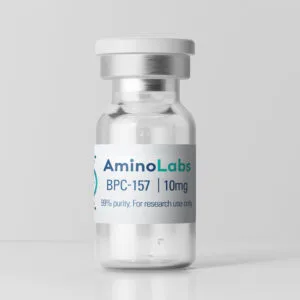
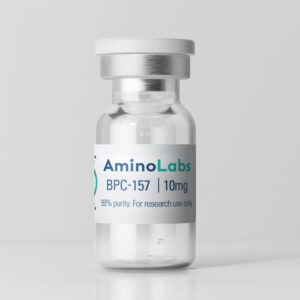
BPC-157 is a 15-amino-acid fragment of a protective protein found in human gastric juice. It is studied in animal models for accelerated healing of tendon, ligament, muscle, gut mucosa, bone and nerve tissue, with human evidence limited to three small uncontrolled pilot studies. This educational protocol presents the subcutaneous convention: 250–500 mcg once daily for general recovery, or 250 mcg twice daily for acute injury or post-surgical support, in cycles of 4–8 weeks on and 2–4 weeks off. The 10 mg vial is reconstituted with 2.0 mL bacteriostatic water, giving whole-unit measurements for both doses on a U-100 syringe.
- Reconstitute: Add 2 mL bacteriostatic water → 5 mg/mL concentration.
- Dose range: 250–500 mcg (0.25–0.5 mg) per injection, once daily, subcutaneously; or 250 mcg twice daily for acute injury (4–8 weeks on, then 2–4 weeks off).
- Easy measuring: At 5 mg/mL, 1 unit = 0.01 mL = 50 mcg on a U-100 insulin syringe.
- Storage: Lyophilized: freeze at −20 °C (−4 °F); after reconstitution, refrigerate at 2–8 °C (35.6–46.4 °F) and use within 28 days.
- Vial yield: At 5 mg/mL the vial holds 20 doses at 500 mcg or 40 doses at 250 mcg, so a 4-week course at the standard daily dose uses 2 vials and an 8-week course uses 3.
Dosing & Reconstitution Guide
Standard Protocol (2 mL = 5 mg/mL)
| Use case | Dose | Calculated volume | U-100 scale value (1 mL capacity) | V1 nominal setting (units) |
|---|---|---|---|---|
| General recovery | 250 mcg (0.25 mg) | 0.05 mL | 5 units | 5 units |
| Standard daily dose | 500 mcg (0.5 mg) | 0.1 mL | 10 units | 10 units |
| Acute injury (twice daily) | 250 mcg (0.25 mg) | 0.05 mL | 5 units | 5 units |
Calculation basis: The table uses the labelled 10 mg amount and assumes a final solution volume of 2 mL (5 mg/mL). BAC volume does not change the amount of peptide. These are nominal calculations, not validation of preparation, compatibility or treatment.
Frequency: Once daily for general recovery (250–500 mcg). For acute injury or post-surgical support, 250 mcg twice daily (morning and evening), injected near the injury site where practical.
Cycle: 4–8 weeks on, then 2–4 weeks off.
Reconstitution Steps
- Allow the vial to reach room temperature before opening to minimize condensation.
- Draw 2 mL bacteriostatic water with a sterile syringe.
- Inject slowly down the vial wall to minimize foaming; avoid shaking.
- Gently swirl or roll the vial until the powder is fully dissolved.
- Label the vial with the reconstitution date and refrigerate at 2–8 °C (35.6–46.4 °F), protected from light.
- Use reconstituted solution within 28 days for maximum potency and safety.
Important: This guide is for educational purposes only and is not medical advice. For research use only. Not for human consumption.
Supplies Needed
Plan based on a 4–8 week daily protocol at the standard 500 mcg dose; the twice-daily acute-injury schedule uses the same amount per day but doubles the syringe count (14 per week: 56 for 4 weeks, 112 for 8 weeks) and the swab count (112 → 2 boxes; 224 → 3 boxes).
- Peptide Vials (BPC-157, 10 mg each):
- 4 weeks ≈ 2 vials (14 mg total used)
- 8 weeks ≈ 3 vials (28 mg total used)
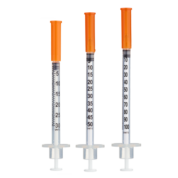
- Insulin Syringes (U-100):
- Per week: 7 syringes
- 4 weeks: 28 syringes
- 8 weeks: 56 syringes
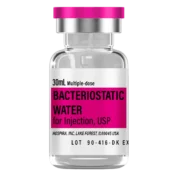
- Bacteriostatic Water (30 mL bottles): Use 2 mL per vial for reconstitution.
- 4 weeks (2 vials): 4 mL → 1 × 30 mL bottle
- 8 weeks (3 vials): 6 mL → 1 × 30 mL bottle
Note: Use bacteriostatic water within 28 days after opening; a vial reconstituted more than 28 days after the bottle was first opened needs a new bottle.
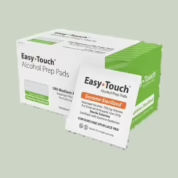
- Alcohol Swabs: One for the vial stopper + one for the injection site each injection.
- 4 weeks: 56 swabs → recommend 1 × 100-count box
- 8 weeks: 112 swabs → recommend 2 × 100-count boxes
Protocol Overview
Concise summary of the daily regimen.
- Goal: Support soft-tissue and gut repair through the angiogenic and growth-factor signaling studied in animal models.
- Schedule: Daily subcutaneous injections (once daily, or twice daily for acute injury) for 4–8 weeks, followed by a 2–4 week break.
- Dose Range: 250 mcg (0.25 mg) to 500 mcg (0.5 mg) once daily, or 250 mcg (0.25 mg) twice daily (500 mcg/day) for acute injury or post-surgical support.
- Reconstitution: 2 mL per 10 mg vial (5 mg/mL) for accurate unit measurements on standard insulin syringes.
- Storage: Lyophilized frozen at −20 °C (−4 °F); reconstituted refrigerated at 2–8 °C (35.6–46.4 °F); use within 28 days; avoid repeated freeze–thaw cycles.
- Evidence: Animal data dominant, with three small uncontrolled human pilot studies and no human RCT; dosing-site conventions converge tightly on 250–500 mcg once or twice daily for 4–8 weeks, so confidence is medium for the convention and low for any specific figure.
Dosing Protocol
Suggested daily approach based on preclinical data and research-community conventions.
- General recovery: 250 mcg (0.25 mg) once daily; at 5 mg/mL this is 5 units (0.05 mL).
- Standard daily dose: 500 mcg (0.5 mg) once daily, the most-cited single figure; 10 units (0.10 mL).
- Acute injury (twice daily): 250 mcg (0.25 mg) in the morning and 250 mcg in the evening (500 mcg/day total); 5 units per injection.
- Frequency: Once daily for general recovery; twice daily for acute injury or post-surgical support, injected near the injury site where practical.
- Timing: No strong convention for the subcutaneous route; morning, or a morning and evening split about 12 hours apart when twice daily. Rotate injection sites.
- Cycle: 4–8 weeks on, then 2–4 weeks off. Sources range from 4 to 12 weeks on, and one uses an 8-week break.
- Titration: Not required; most sources start at the working dose. Some begin at 250 mcg once daily for 1–2 weeks before stepping up to 500 mcg or to twice daily.
- Maintenance: One source describes 250 mcg once daily or on alternate days after the cycle; most sources hold the working dose for the cycle and then stop.
Storage Instructions
Proper storage preserves product quality and efficacy.
- Lyophilized (powder): Store at −20 °C (−4 °F) in a dry, dark place; for short-term storage (under a few months), 2–8 °C (35.6–46.4 °F) refrigeration is acceptable. Avoid humidity to prevent degradation.
- Reconstituted (solution): Refrigerate at 2–8 °C (35.6–46.4 °F) and do not freeze; use within 28 days (sources range from 14 to 28 days).
- Allow vials to reach room temperature before opening to minimize condensation uptake.
- Each vial lasts about 20 days at 500 mcg/day, inside the 28-day window; at 250 mcg once daily a vial would stretch to 40 days, so discard at 28 days regardless of remaining volume.
Important Notes
Practical considerations for consistency and safety.
- Use new sterile insulin syringes for each injection; dispose in a proper sharps container.
- Rotate injection sites systematically (abdomen, thighs, upper arms) to reduce local irritation and avoid lipohypertrophy.
- Injecting near the injury site is a community convention for localized goals; it is not supported by human data, and a standard abdominal or thigh site is the fallback where the injury site is impractical.
- Not approved by Health Canada or the FDA; sold for research use only. BPC-157 is prohibited by WADA (S0, non-approved substances) for tested athletes.
- Evidence caveat: only three small uncontrolled human reports exist (intra-articular knee, interstitial cystitis, intravenous safety) plus an unpublished oral Phase 1; every milligram figure in circulation is convention, and one evidence review declines to endorse any dose.
- Sources list active cancer and pregnancy as contraindications because of the angiogenic mechanism.
- Some sources reconstitute with 5 mL; that volume will not fit the 3 mL Amino Labs vial, and the 2.0 mL used here yields whole units at both 250 and 500 mcg.
- Stacking convention in sources pairs BPC-157 with TB-500 at matched 500 mcg daily, or uses blends such as KLOW or GLOW; these combinations are untested in humans.
How This Works
BPC-157 (Body Protection Compound-157) is a 15-amino-acid fragment of a protein found in human gastric juice, which is why it is stable in the stomach and why oral use is favored for gut-directed goals. It upregulates vascular endothelial growth factor (VEGF) and related growth-factor signaling, promoting angiogenesis and fibroblast migration into damaged tissue, interacts with the nitric oxide system, and modulates inflammatory and dopaminergic pathways. In rodent models these actions accelerate healing of tendon, muscle, gut mucosa, bone and nerve tissue, and dosing sites scale the rat 10 mcg/kg figure to roughly 110–560 mcg/day in humans, which is where the 250–500 mcg convention sits. Human evidence is limited to three small uncontrolled pilot studies (intra-articular knee pain, interstitial cystitis and an intravenous safety pilot) and one unpublished oral Phase 1; no controlled trial exists, so timing claims such as pain relief in weeks 1–2 and functional gains in weeks 3–4 come from community reports rather than trial data.
Potential Benefits & Side Effects
Observations from preclinical literature and research-community reports.
Potential Benefits:
- Tendon, ligament and muscle repair in animal models.
- Gut-lining protection and ulcer or inflammatory-bowel support in animal models, with the oral route emphasized for those goals.
- Angiogenesis and collagen production, the mechanism behind the tissue-repair findings.
- Bone-fracture and nerve healing in animal models.
- Community reports of reduced pain and inflammation in weeks 1–2 and improved range of motion by weeks 3–4; these timelines do not come from controlled human data.
Potential Side Effects:
- Injection-site redness, swelling, bruising and transient soreness.
- Headache, nausea, dizziness and fatigue (less common).
- Theoretical angiogenesis concern with existing tumors; sources list active cancer and pregnancy as contraindications.
- Prohibited by WADA for tested athletes.
- No controlled human safety data; long-term effects are unknown.
Lifestyle Factors
Complementary strategies for injury recovery.
- Follow a structured rehabilitation or progressive-loading program; repair signaling has little to act on without appropriate mechanical stimulus.
- Prioritize protein intake (1.2–1.6 g/kg body weight) and overall energy adequacy to supply the amino acids collagen synthesis requires.
- Sleep 7–9 hours; most tissue repair occurs during sleep.
- Limit alcohol and tobacco, both of which impair circulation and wound healing.
- Track pain, swelling and range of motion weekly to judge response over the 4–8 week cycle, and note the cycle start date so the 2–4 week break is observed.
Injection Technique
General subcutaneous injection guidance from clinical best-practice resources.
- Clean the vial stopper and chosen skin site with separate alcohol swabs; allow both to dry completely before proceeding.
- Pinch a fold of skin between your fingers; insert the needle at a 45–90° angle into the subcutaneous tissue (fatty layer, not muscle).
- Do not aspirate (pull back the plunger) when giving a subcutaneous injection.
- Inject the solution slowly and steadily; wait at least 6 seconds after injection before withdrawing the needle to ensure complete delivery and minimize leakage.
- Withdraw the needle and apply light pressure with a clean swab; avoid rubbing vigorously.
- Rotate injection sites systematically (abdomen, thighs, upper arms) to prevent lipohypertrophy and maintain consistent absorption.
- Dispose of used syringes and needles immediately in a proper sharps container.
Recommended Source
We recommend Amino Labs for high-purity BPC-157 (10 mg vials).
Why Amino Labs?
- Third-party tested: Each batch includes Certificate of Analysis (COA) verifying purity and composition.
- Consistent quality: ISO-aligned manufacturing and handling standards ensure reliable product integrity.
- Cold-chain integrity: Temperature-controlled shipping and storage throughout fulfillment process.
- Research-grade purity: Suitable for educational and research applications requiring high-quality peptides.
Note: Product availability and specifications subject to change. Verify current product details on supplier website.
Important Note
This content is intended for therapeutic educational purposes only and does not constitute medical advice, diagnosis, or treatment.