Quickstart Highlights
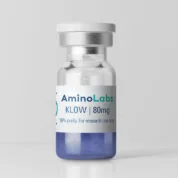
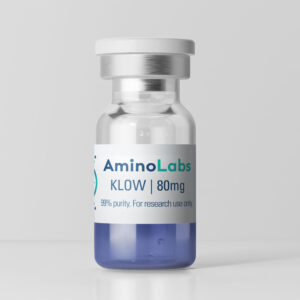
KLOW is a four-peptide repair blend supplied in a fixed 5:1:1:1 ratio: 50 mg of GHK-Cu with 10 mg each of BPC-157, TB-500 and KPV in a single 80 mg vial. Research-community protocols use the combination for soft-tissue and tendon recovery, skin and collagen remodelling, and gut or systemic inflammation, although no published study has tested the four peptides together. This educational protocol presents once-daily subcutaneous injections over a 4–6 week cycle, starting at 2 mg of blend and moving to 4 mg from week 3, using a 2.4 mL reconstitution so that the common 250 mcg and 500 mcg per-peptide points fall on whole insulin-syringe units.
- Reconstitute: Add 2.4 mL bacteriostatic water → 33.33 mg/mL concentration.
- Dose range: 2–4 mg of total blend once daily, subcutaneously, delivering 250–500 mcg each of BPC-157, TB-500 and KPV plus 1.25–2.5 mg GHK-Cu (4–6 week cycle, then 2–4 weeks off).
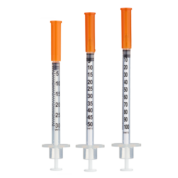
- Easy measuring: At 33.33 mg/mL, 1 unit = 0.01 mL = 333.33 mcg of blend (about 208 mcg GHK-Cu + 41.7 mcg each of BPC-157, TB-500 and KPV) on a U-100 insulin syringe.
- Storage: Lyophilized: freeze at −20 °C (−4 °F); after reconstitution, refrigerate at 2–8 °C (35.6–46.4 °F) and use within 28 days.
- Cycle note: Sources build in an off period because of the copper carried by GHK-Cu; the blend delivers 1.25–2.5 mg of GHK-Cu per day, so 4–6 weeks on is followed by 2–4 weeks off.
Dosing & Reconstitution Guide
Standard Protocol (per-component amounts shown) (2.4 mL = 33.33 mg/mL)
| Week | Dose | Calculated volume | U-100 scale value (1 mL capacity) | V1 nominal setting (units) |
|---|---|---|---|---|
| Weeks 1–2 | 2 mg (2000 mcg) — 250 mcg each of BPC-157, TB-500 and KPV + 1.25 mg GHK-Cu | 0.06 mL | 6 units | 6 units |
| Week 3 onward | 4 mg (4000 mcg) — 500 mcg each of BPC-157, TB-500 and KPV + 2.5 mg GHK-Cu | 0.12 mL | 12 units | 12 units |
Calculation basis: The table uses the labelled 80 mg amount and assumes a final solution volume of 2.4 mL (33.33 mg/mL). BAC volume does not change the amount of peptide. These are nominal calculations, not validation of preparation, compatibility or treatment.
Frequency: Once daily, subcutaneously, near the injury site where practical. Higher-volume days may be split morning and evening.
Cycle: 4–6 weeks on, then 2–4 weeks off (the GHK-Cu copper load is the reason for the off period).
Reconstitution Steps
- Allow the vial to reach room temperature before opening to minimize condensation.
- Draw 2.4 mL bacteriostatic water with a sterile syringe.
- Inject slowly down the vial wall to minimize foaming; avoid shaking.
- Gently swirl or roll the vial until the powder is fully dissolved.
- Label the vial with the reconstitution date and refrigerate at 2–8 °C (35.6–46.4 °F), protected from light.
- Use reconstituted solution within 28 days for maximum potency and safety.
Important: This guide is for educational purposes only and is not medical advice. For research use only. Not for human consumption.
Supplies Needed
Plan based on a 4–6 week once-daily protocol (2 mg of blend in weeks 1–2, then 4 mg daily).
- Peptide Vials (KLOW, 80 mg each):
- 4 weeks ≈ 2 vials (84 mg total used)
- 6 weeks ≈ 2 vials (140 mg total used)
- Insulin Syringes (U-100):
- Per week: 7 syringes
- 4 weeks: 28 syringes
- 6 weeks: 42 syringes
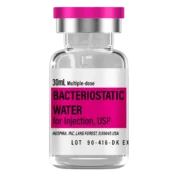
- Bacteriostatic Water (30 mL bottles): Use 2.4 mL per vial for reconstitution.
- 4 weeks (2 vials): 4.8 mL → 1 × 30 mL bottle
- 6 weeks (2 vials): 4.8 mL → 1 × 30 mL bottle
Note: Use bacteriostatic water within 28 days after opening; a vial reconstituted more than 28 days after the bottle was first opened needs a new bottle.
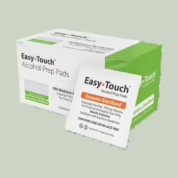
- Alcohol Swabs: One for the vial stopper + one for the injection site each injection.
- 4 weeks: 56 swabs → recommend 1 × 100-count box
- 6 weeks: 84 swabs → recommend 1 × 100-count box
Protocol Overview
Concise summary of the once-daily four-peptide repair regimen.
- Goal: Support soft-tissue, tendon and skin repair while reducing inflammation by combining GHK-Cu, BPC-157, TB-500 and KPV in one daily injection.
- Schedule: Daily subcutaneous injections, placed near the injury site where practical, for 4–6 weeks followed by a 2–4 week break.
- Dose Range: 2 mg of total blend daily (250 mcg each of BPC-157, TB-500 and KPV plus 1.25 mg GHK-Cu) in weeks 1–2, rising to 4 mg daily (500 mcg each plus 2.5 mg GHK-Cu) from week 3; in syringe terms 2000–4000 mcg of blend per injection.
- Reconstitution: 2.4 mL per 80 mg vial (33.33 mg/mL) for accurate unit measurements on standard insulin syringes.
- Storage: Lyophilized frozen at −20 °C (−4 °F); reconstituted refrigerated at 2–8 °C (35.6–46.4 °F); use within 28 days; avoid repeated freeze–thaw cycles.
- Evidence: Community convention with no human data for the combination: every source states that no published study has evaluated the four-peptide KLOW blend, and the components themselves rest on animal data and small pilots (BPC-157, TB-500, KPV) or topical and gene-expression work (GHK-Cu). Confidence is low; the unit-based convention is vendor-propagated and one source differs from the others by tenfold.
Dosing Protocol
Suggested daily approach based on research-community blend conventions and the single-peptide ranges of each component.
- Weeks 1–2: 2 mg of blend (2000 mcg) once daily, which delivers 250 mcg each of BPC-157, TB-500 and KPV plus 1.25 mg GHK-Cu; 6 units at the 2.4 mL reconstitution.
- Week 3 onward: 4 mg of blend (4000 mcg) once daily, which delivers 500 mcg each of BPC-157, TB-500 and KPV plus 2.5 mg GHK-Cu; 12 units.
- Frequency: Once daily, subcutaneously, near the injury site where practical. Higher-volume days may be split into morning and evening injections.
- Timing: No convention exists for morning versus evening; sources describe either. Keep the time of day consistent and record the site used.
- Cycle: 4–6 weeks on, then 2–4 weeks off. The off period is driven by the copper load from GHK-Cu, not by the three smaller peptides. Sources describe an extended 8–12 week option with 4–8 weeks off, which is outside this page.
- Titration: Most sources start at the working dose; this page holds the 2 mg amount for two weeks before stepping to 4 mg so that injection-site tolerance and copper-related symptoms can be observed first.
- Maintenance: At the end of the cycle, sources describe either stopping entirely or dropping to two or three injections per week; the standard approach is a full break before any repeat cycle.
Storage Instructions
Proper storage preserves product quality and efficacy.
- Lyophilized (powder): Store at −20 °C (−4 °F) for long-term storage, or refrigerated at 2–8 °C (35.6–46.4 °F) for short periods, dry and protected from light.
- Reconstituted (solution): Refrigerate at 2–8 °C (35.6–46.4 °F), protected from light, and do not freeze. Use within 28 days; sources range from 14 to 42 days, so 28 days is the working ceiling on this page.
- Allow the vial to reach room temperature before opening to minimize condensation uptake.
- A clear solution with a light-blue tint is normal and comes from the copper in GHK-Cu; a change to cloudiness or visible particulates is a reason to discard the vial.
Important Notes
Practical considerations for consistency and safety.
- Use new sterile insulin syringes for each injection; dispose in a proper sharps container.
- Rotate injection sites systematically (abdomen, thighs, upper arms); where the goal is a specific injury, sources describe placing the injection near that site, with the surrounding skin rotated day to day.
- The dose is a fixed ratio: at 2.4 mL, 1 unit contains about 208 mcg GHK-Cu plus 41.7 mcg each of BPC-157, TB-500 and KPV. The 2 mg and 4 mg steps match the 250 mcg and 500 mcg points used for BPC-157 on its own, and the GHK-Cu share lands inside the usual 1–3 mg daily range for that peptide.
- Copper load from GHK-Cu is the main safety consideration. Metallic taste, unusual fatigue, nausea or abdominal pain during the cycle are described as signs of copper accumulation; sources recommend monitoring copper and zinc on longer protocols and keeping the off period.
- Not approved by Health Canada or the FDA; research use only. BPC-157 and TB-500 are prohibited by WADA, so the blend is unsuitable for tested athletes.
- Evidence caveat: no published study has evaluated the four-peptide KLOW combination, and the unit-based convention comes from vendor and dosing-site pages. The 10–20 units/day at 3 mL convention is shared by five of six blend sources, but one source gives a figure roughly tenfold lower.
- Contraindications cited by sources: active or recent cancer (angiogenesis from BPC-157, TB-500 and GHK-Cu), Wilson’s disease or other copper-metabolism disorders, pregnancy and WADA-tested sport.
- TB-500 in this blend is delivered at sub-milligram amounts daily, not in the 2–2.5 mg twice-weekly loading pattern used for standalone TB-500; do not add a separate TB-500 loading schedule on top of the blend.
How This Works
KLOW combines four repair-oriented peptides in a fixed 5:1:1:1 ratio, and the rationale described by sources is that each one acts on a different stage of tissue repair. GHK-Cu is a copper-binding tripeptide that delivers copper to the tissue and drives collagen and elastin synthesis, remodelling and skin repair; it is the component with the most human data, mostly from topical and gene-expression studies. BPC-157 upregulates VEGF and growth-factor signaling, promoting angiogenesis and tendon and soft-tissue healing in animal models. TB-500 sequesters actin, which promotes cell migration into injured tissue and new vessel formation. KPV, the C-terminal tripeptide of alpha-MSH, suppresses NF-kB-driven inflammation without the pigmentation effects of the full hormone. Sources describe the combination as overlapping repair pathways delivered in one injection, with the GHK-Cu share determining the cycle length because of its copper content. No study has tested the four peptides together, so the mechanism is inferred from each component separately.
Potential Benefits & Side Effects
Observations from animal and early human literature on the individual components; the combination itself has not been studied.
Potential Benefits:
- Combined soft-tissue, tendon and joint repair, based on BPC-157 and TB-500 animal models of tendon, ligament and muscle healing.
- Skin quality, collagen remodelling and hair or nail improvement attributed to GHK-Cu, which has human topical and gene-expression data.
- Gut and systemic anti-inflammatory support from KPV and BPC-157, shown in mouse colitis and cell models.
- Wound-healing acceleration reported by community sources around weeks 3–4 of a cycle.
- Angiogenesis and cell migration to injury sites in animal models, which is also the basis of the cancer contraindication.
Potential Side Effects:
- Injection-site redness, swelling or sensitivity; a light blue-green tint at the site from GHK-Cu is cosmetic.
- Transient fatigue in the first 1–2 weeks (attributed to TB-500), headache, light-headedness, nausea, vivid dreams or appetite change.
- Copper accumulation with prolonged GHK-Cu use: metallic taste, fatigue, nausea and abdominal pain; copper and zinc monitoring is described for long protocols.
- Angiogenesis concern: active or recent cancer is listed as a contraindication for three of the four components.
- A temporary flare of old injuries is reported as uncommon by one source.
- Interactions among the four peptides are unknown; no human safety data exist for the combination.
Lifestyle Factors
Complementary strategies for a tissue-repair protocol.
- Maintain adequate protein intake (1.2–1.6 g/kg body weight) and total calories so that collagen and tissue synthesis have the raw material to use.
- Load the recovering tissue progressively under qualified guidance; controlled mechanical loading, not rest alone, directs tendon and ligament remodelling.
- Include dietary sources of vitamin C and zinc, which support collagen cross-linking and balance the copper delivered by GHK-Cu.
- Prioritize 7–9 hours of sleep, when most tissue repair and growth-hormone release occurs.
- Avoid smoking and limit alcohol, both of which impair angiogenesis and wound healing.
- Keep a simple log of injection site, dose and symptoms such as metallic taste or fatigue so that copper-related effects are caught early.
Injection Technique
General subcutaneous injection guidance from clinical best-practice resources.
- Clean the vial stopper and chosen skin site with separate alcohol swabs; allow both to dry completely before proceeding.
- Pinch a fold of skin between your fingers; insert the needle at a 45–90° angle into the subcutaneous tissue (fatty layer, not muscle).
- Do not aspirate (pull back the plunger) when giving a subcutaneous injection.
- Inject the solution slowly and steadily; wait at least 6 seconds after injection before withdrawing the needle to ensure complete delivery and minimize leakage.
- Withdraw the needle and apply light pressure with a clean swab; avoid rubbing vigorously.
- Rotate injection sites systematically (abdomen, thighs, upper arms) to prevent lipohypertrophy and maintain consistent absorption.
- Dispose of used syringes and needles immediately in a proper sharps container.
Recommended Source
We recommend Amino Labs for high-purity KLOW (80 mg vials).
Why Amino Labs?
- Third-party tested: Each batch includes Certificate of Analysis (COA) verifying purity and composition.
- Consistent quality: ISO-aligned manufacturing and handling standards ensure reliable product integrity.
- Cold-chain integrity: Temperature-controlled shipping and storage throughout fulfillment process.
- Research-grade purity: Suitable for educational and research applications requiring high-quality peptides.
Note: Product availability and specifications subject to change. Verify current product details on supplier website.
Important Note
This content is intended for therapeutic educational purposes only and does not constitute medical advice, diagnosis, or treatment.