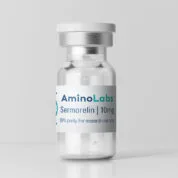
Quickstart Highlights
Sermorelin is a synthetic 29-amino-acid fragment of growth hormone-releasing hormone (GHRH 1–29) that prompts the pituitary to release growth hormone in a physiological, pulsatile pattern and raises IGF-1. It was FDA-approved as Geref (1997–2008) for pediatric growth hormone deficiency and diagnostic use, and remains compoundable by prescription in the United States. This educational protocol presents a nightly subcutaneous schedule given 30–60 minutes before bed on an empty stomach: 100–200 mcg in weeks 1–2, 300 mcg in weeks 3–8 and 500 mcg from week 9 if warranted, over a 3–6 month course, using a 2.0 mL reconstitution (5 mg/mL) for whole-unit measurement on a U-100 insulin syringe.
- Reconstitute: Add 2 mL bacteriostatic water → 5 mg/mL concentration.
- Dose range: 100–500 mcg (0.1–0.5 mg) once nightly, 5 nights on / 2 off, subcutaneously, 30–60 minutes before bed on an empty stomach (3–6 month course).
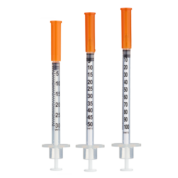
- Easy measuring: At 5 mg/mL, 1 unit = 0.01 mL = 50 mcg on a U-100 insulin syringe.
- Storage: Lyophilized: freeze at −20 °C (−4 °F); after reconstitution, refrigerate at 2–8 °C (35.6–46.4 °F) and use within 28 days.
- Label: The historical Geref label dosed every night at bedtime (pediatric 30 mcg/kg; adult compounding reference 0.2–0.3 mg); most dosing references use 5 nights on / 2 off.
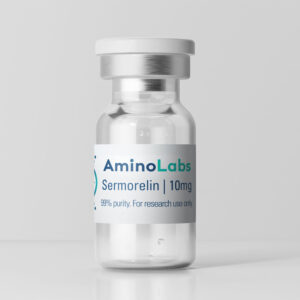
Dosing & Reconstitution Guide
Standard / Gradual Titration (2 mL = 5 mg/mL)
| Week | Dose | Calculated volume | U-100 scale value (1 mL capacity) | V1 nominal setting (units) |
|---|---|---|---|---|
| Weeks 1–2 | 100 mcg (0.1 mg) | 0.02 mL | 2 units | 2 units |
| Weeks 1–2 (upper) | 200 mcg (0.2 mg) | 0.04 mL | 4 units | 4 units |
| Weeks 3–8 | 300 mcg (0.3 mg) | 0.06 mL | 6 units | 6 units |
| Week 9 onward (if warranted) | 500 mcg (0.5 mg) | 0.1 mL | 10 units | 10 units |
Calculation basis: The table uses the labelled 10 mg amount and assumes a final solution volume of 2 mL (5 mg/mL). BAC volume does not change the amount of peptide. These are nominal calculations, not validation of preparation, compatibility or treatment.
Frequency: Once nightly, 30–60 minutes before bed on an empty stomach (2–3 hours after the last meal). Most dosing references use 5 nights on / 2 off; the historical Geref label and compounding pharmacies dose every night.
Cycle: 3–6 month course.
Reconstitution Steps
- Allow the vial to reach room temperature before opening to minimize condensation.
- Draw 2 mL bacteriostatic water with a sterile syringe.
- Inject slowly down the vial wall to minimize foaming; avoid shaking.
- Gently swirl or roll the vial until the powder is fully dissolved.
- Label the vial with the reconstitution date and refrigerate at 2–8 °C (35.6–46.4 °F), protected from light.
- Use reconstituted solution within 28 days for maximum potency and safety.
Important: This guide is for educational purposes only and is not medical advice. For research use only. Not for human consumption.
Supplies Needed
Plan based on an 8–24 week protocol (5 nights per week) following the titration path (100 mcg weeks 1–2, 300 mcg weeks 3–8, 500 mcg from week 9); a reconstituted vial is used within 28 days, so one vial is opened every 4 weeks and counts include solution discarded under that rule.
- Peptide Vials (Sermorelin, 10 mg each):
- 8 weeks ≈ 2 vials (10 mg of doses drawn; 11 mg if starting at 200 mcg)
- 12 weeks ≈ 3 vials (20 mg of doses drawn)
- 24 weeks ≈ 6 vials (50 mg of doses drawn)
- Insulin Syringes (U-100):
- Per week: 5 syringes
- 8 weeks: 40 syringes
- 12 weeks: 60 syringes
- 24 weeks: 120 syringes
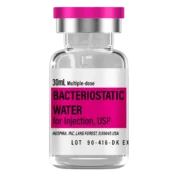
- Bacteriostatic Water (30 mL bottles): Use 2 mL per vial for reconstitution.
- 8 weeks (2 vials): 4 mL → 2 × 30 mL bottles
- 12 weeks (3 vials): 6 mL → 3 × 30 mL bottles
- 24 weeks (6 vials): 12 mL → 6 × 30 mL bottles
Note: Use bacteriostatic water within 28 days after opening; a vial reconstituted more than 28 days after the bottle was first opened needs a new bottle.
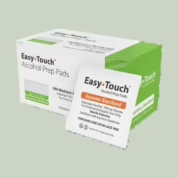
- Alcohol Swabs: One for the vial stopper + one for the injection site each injection.
- 8 weeks: 80 swabs → recommend 1 × 100-count box
- 12 weeks: 120 swabs → recommend 2 × 100-count boxes
- 24 weeks: 240 swabs → recommend 3 × 100-count boxes
Protocol Overview
Concise summary of the nightly bedtime regimen.
- Goal: Restore pulsatile growth hormone release and raise IGF-1 to support sleep quality, recovery and body composition while preserving the pituitary feedback loop.
- Schedule: Subcutaneous injections once nightly before bed, 5 nights on / 2 off (or every night per the label convention), over a 3–6 month course.
- Dose Range: 100 mcg (0.1 mg) to 500 mcg (0.5 mg) nightly: 100–200 mcg in weeks 1–2, 300 mcg in weeks 3–8, and 500 mcg from week 9 onward only if warranted by response.
- Reconstitution: 2 mL per 10 mg vial (5 mg/mL) for accurate unit measurements on standard insulin syringes.
- Storage: Lyophilized frozen at −20 °C (−4 °F); reconstituted refrigerated at 2–8 °C (35.6–46.4 °F); use within 28 days; avoid repeated freeze–thaw cycles.
- Evidence: Based on the FDA-approved Geref label (route, bedtime timing and dose range) plus concordant compounding-pharmacy references; the 5-on / 2-off pattern and 3–6 month course length are conventions rather than trial-derived, so confidence is high for dose and timing and medium for cycling.
Dosing Protocol
Suggested nightly titration approach based on the historical FDA label, compounding-pharmacy practice and research-community conventions.
- Weeks 1–2: 100 mcg (0.1 mg) once nightly to establish tolerance.
- Weeks 1–2 (upper): 200 mcg (0.2 mg) once nightly for those starting at the lower end of the compounding-pharmacy adult reference (0.2–0.3 mg).
- Weeks 3–8: 300 mcg (0.3 mg) once nightly, the standard adult reference amount.
- Week 9 onward (if warranted): 500 mcg (0.5 mg) once nightly, an upper reference some sources use after 4–8 weeks based on IGF-1 and response.
- Frequency: Once per night (subcutaneous injection). Most dosing references use 5 nights on / 2 off to limit desensitization; the Geref label and compounding pharmacies dose every night.
- Timing: 30–60 minutes before bed on an empty stomach (2–3 hours after the last meal, no food for about 1 hour after) to coincide with the first slow-wave-sleep GH pulse.
- Cycle: 3–6 month course, then reassess; sleep and recovery changes are reported within 2–4 weeks and body-composition changes over 3–6 months.
- Monitoring: Baseline and 6–12 week IGF-1, fasting glucose and a thyroid panel are the markers sources describe.
Storage Instructions
Proper storage preserves product quality and efficacy.
- Lyophilized (powder): Store at −20 °C (−4 °F) protected from light for long-term storage; the label specifies 2–8 °C (35.6–46.4 °F) refrigeration, which is acceptable for shorter periods.
- Reconstituted (solution): Refrigerate at 2–8 °C (35.6–46.4 °F) and do not freeze. Use within 28 days; sources range from 14 days to a 30-day pharmacy window, so 28 days is the practical outside limit.
- Allow vials to reach room temperature before opening to minimize condensation uptake.
- Store reconstituted vials upright and protected from light; swirl rather than shake when dissolving.
Important Notes
Practical considerations for consistency and safety.
- Use new sterile insulin syringes for each injection; dispose in a proper sharps container.
- Rotate injection sites systematically (abdomen at least 2 inches from the navel, thighs, upper arms) to reduce local irritation and avoid lipohypertrophy; about 1 in 6 label-era patients had injection-site reactions.
- Inject slowly and steadily; wait a few seconds before withdrawing the needle to ensure complete delivery.
- Label history: Geref (Serono) was FDA-approved in 1997 and withdrawn in 2008 for commercial reasons, not safety. The label dosed once daily at bedtime (30 mcg/kg pediatric; adult compounding reference 0.2–0.3 mg) and supplied 2 mL of diluent per vial.
- Regulatory: Not approved by Health Canada; in the United States sermorelin remains on the FDA 503A Category 1 list and can be compounded with a prescription. The research vial is for research use only.
- Evidence caveat: The label covers pediatric GHD and diagnostic use; adult nightly protocols rest on compounding-pharmacy practice and small older trials rather than modern RCTs, and sources describe them as conservative practice rather than an empirically validated optimum.
- Fasted timing: Sources specify an empty stomach (2–3 hours after the last meal, no food for about 1 hour after) so the injection coincides with the natural nocturnal GH pulse; keep this consistent from night to night.
- Monitor IGF-1 and thyroid function: hypothyroidism was reported in about 6.5% of FDA-era trial participants, and anti-GRF antibodies develop in a large proportion of patients without loss of effect. Caution with active malignancy.
How This Works
Sermorelin is a synthetic 29-amino-acid peptide corresponding to the N-terminal fragment of human growth hormone-releasing hormone (GHRH 1–29). It binds GHRH receptors on pituitary somatotrophs and triggers a physiological pulse of growth hormone, which in turn raises hepatic IGF-1 and drives downstream effects on sleep architecture, recovery, lipolysis and lean mass. Because the pituitary and the somatostatin feedback loop remain intact, GH release stays pulsatile and self-limiting, so the risk of GH excess is lower than with exogenous growth hormone. The peptide itself has a half-life of only 11–12 minutes, which is why dosing is timed 30–60 minutes before sleep on an empty stomach to coincide with the first slow-wave-sleep GH pulse. The historical Geref label established the route, bedtime timing and dose range; sources report sleep and recovery changes within 2–4 weeks and body-composition shifts over 3–6 months, and a cited 16-week trial found sustained response without desensitization.
Potential Benefits & Side Effects
Observations from the historical FDA label, compounding-pharmacy practice and older clinical literature.
Potential Benefits:
- Stimulates endogenous pulsatile GH release and raises IGF-1 (label mechanism, confirmed in clinical use).
- Improved sleep depth and recovery, reported within 2–4 weeks in dosing references.
- Body-composition shifts (lean mass up, fat down) over 3–6 months, reported in compounding-pharmacy and community sources.
- Preserves negative feedback via somatostatin, so lower risk of GH excess than exogenous GH.
- Historically increased growth velocity in GHD children (label indication); a cited 16-week trial showed sustained response without desensitization.
Potential Side Effects:
- Injection-site pain, redness or swelling (about 1 in 6 patients on the label).
- Headache, flushing, dizziness, sleepiness, nausea or vomiting.
- Dysphagia, hives and hyperactivity (label-listed, rare).
- Anti-GRF antibody formation in a large proportion of patients, without loss of growth effect.
- Hypothyroidism reported in about 6.5% of FDA-era trial participants; monitor thyroid function.
- Water retention, tingling and elevated fasting glucose are possible with any GH secretagogue; contraindicated with known hypersensitivity and used with caution in active malignancy.
Lifestyle Factors
Complementary strategies for sleep, recovery and body-composition outcomes.
- Keep a consistent sleep schedule of 7–9 hours; the protocol is timed to the first slow-wave-sleep GH pulse, so irregular bedtimes undermine the rationale.
- Finish the last meal 2–3 hours before the injection and avoid food for about an hour afterward, as sources specify an empty stomach.
- Combine resistance training and aerobic activity to make use of the GH/IGF-1 anabolic and lipolytic effects.
- Maintain a protein-forward, balanced diet to support lean-mass gains over the 3–6 month course.
- Limit alcohol and late-evening screen exposure, both of which degrade slow-wave sleep.
- Track IGF-1, fasting glucose and thyroid markers at baseline and 6–12 weeks, and log sleep quality and body measurements to judge response.
Injection Technique
General subcutaneous injection guidance from clinical best-practice resources.
- Clean the vial stopper and chosen skin site with separate alcohol swabs; allow both to dry completely before proceeding.
- Pinch a fold of skin between your fingers; insert the needle at a 45–90° angle into the subcutaneous tissue (fatty layer, not muscle).
- Do not aspirate (pull back the plunger) when giving a subcutaneous injection.
- Inject the solution slowly and steadily; wait at least 6 seconds after injection before withdrawing the needle to ensure complete delivery and minimize leakage.
- Withdraw the needle and apply light pressure with a clean swab; avoid rubbing vigorously.
- Rotate injection sites systematically (abdomen, thighs, upper arms) to prevent lipohypertrophy and maintain consistent absorption.
- Dispose of used syringes and needles immediately in a proper sharps container.
Recommended Source
We recommend Amino Labs for high-purity Sermorelin (10 mg vials).
Why Amino Labs?
- Third-party tested: Each batch includes Certificate of Analysis (COA) verifying purity and composition.
- Consistent quality: ISO-aligned manufacturing and handling standards ensure reliable product integrity.
- Cold-chain integrity: Temperature-controlled shipping and storage throughout fulfillment process.
- Research-grade purity: Suitable for educational and research applications requiring high-quality peptides.
Note: Product availability and specifications subject to change. Verify current product details on supplier website.
Important Note
This content is intended for therapeutic educational purposes only and does not constitute medical advice, diagnosis, or treatment.