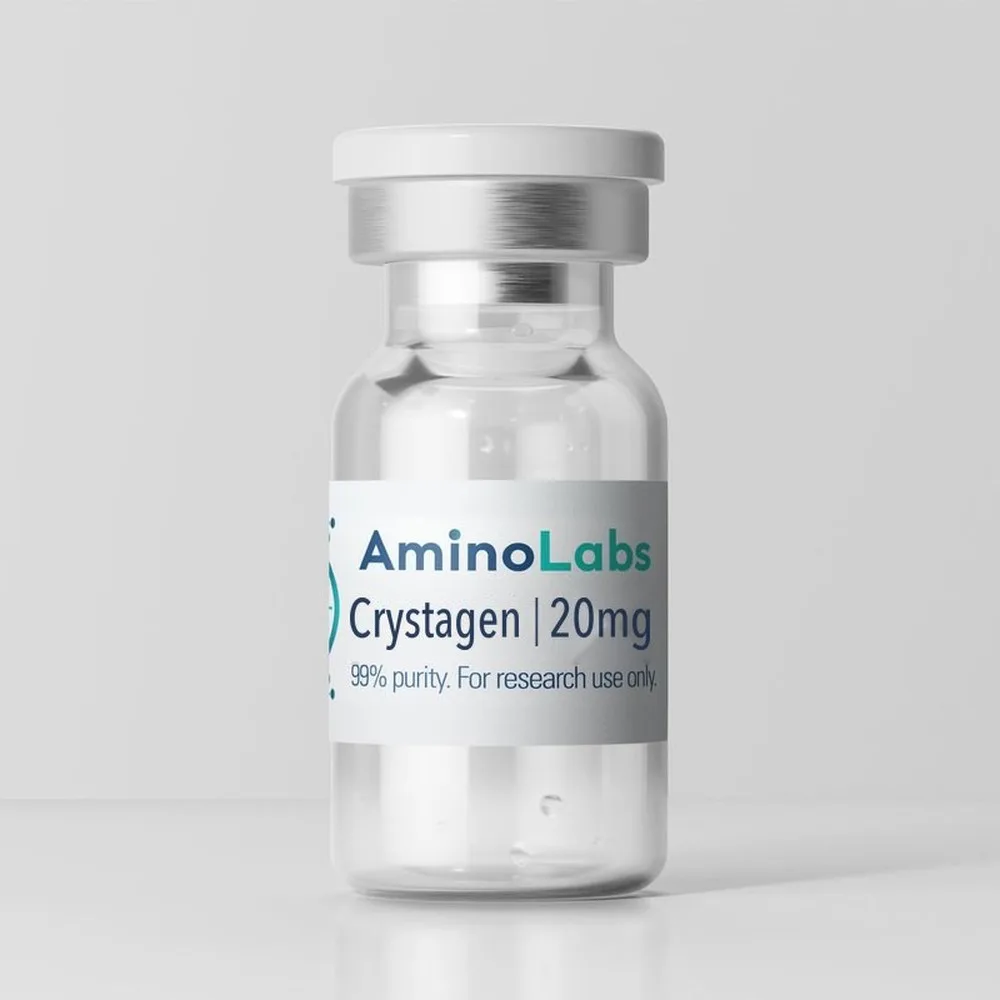
Quickstart Highlights
Crystagen (Glu-Asp-Pro) is a tripeptide bioregulator studied for immune system modulation and cellular regulation. This synthetic peptide is designed to support immune function and has been investigated in research settings for its immunomodulatory properties. This educational protocol presents a once-daily subcutaneous 10–20 day course (repeated two to three times per year) using a practical dilution for clear insulin-syringe measurements.
- Reconstitute: Add 2.0 mL bacteriostatic water (BAC) per labelled 20 mg vial. Calculations assume a final volume of 2.0 mL and nominal 10 mg/mL.
- Typical daily range: 200 mcg–1 mg once daily for a 10–20 day course (500 mcg for Days 1–3, then 1 mg; 200 mcg is the conservative floor); repeat 2–3 times per year, at least 3 months apart.
- Scale conversion: At 10 mg/mL, 1 U-100 unit = 0.01 mL = 0.1 mg (100 mcg). Verify the actual device markings and calibration.
- Storage: Lyophilized: refrigerate at 4 °C (39.2 °F) or freeze at −20 °C (−4 °F); after reconstitution, refrigerate at 4 °C (39.2 °F) for up to 30 days.
Dosing & Reconstitution Guide
Standard Course (2 mL = 10 mg/mL)
| Day | Daily Dose (mcg) | Calculated volume | U-100 scale value (1 mL capacity) | V1 nominal setting (units) |
|---|---|---|---|---|
| Days 1–3 | 500 mcg (0.5 mg) | 0.05 mL | 5 units | 5 units |
| Days 4–20 | 1000 mcg (1 mg) | 0.1 mL | 10 units | 10 units |
| Conservative floor | 200 mcg (0.2 mg) | 0.02 mL | 2 units | 2 units |
Calculation basis: Labelled 20 mg vial, assuming a final solution volume of 2.0 mL: nominal 10 mg/mL. These calculations do not independently establish preparation compatibility, solubility, stability or treatment suitability.
Frequency: Inject once daily subcutaneously for the length of the course (10–20 days: 10-day short course, 20-day standard), then stop. Repeat the course two to three times per year with at least 3 months between courses; bioregulator peptides are not run continuously, and the interval between courses is part of the protocol. Measurement feasibility depends on the actual device and its markings. For ≤10-unit (≤0.10 mL) administrations, consider 30- or 50-unit insulin syringes for improved readability.
Reconstitution Steps
- Draw 2.0 mL bacteriostatic water with a sterile syringe.
- Inject slowly down the vial wall; avoid foaming.
- Gently swirl/roll until dissolved (do not shake).
- Label and refrigerate at 4 °C (39.2 °F), protected from light.
Important: This guide is for educational purposes only and is not medical advice. For research use only. Not for human consumption.
Supplies Needed
Plan based on one 20-day standard course (one daily injection); a 10-day short course uses about half of each item. Multiply by the number of courses per year (two to three).
- Peptide vials (Crystagen, 20 mg each): One 20-day course uses about 18.5 mg → 1 vial per course. Reconstituted solution is used within 28 days, which covers a full course.
- Insulin Syringes (U-100):
- Per course: 20 syringes (1/day)
- Two courses per year: 40 syringes
- Three courses per year: 60 syringes
- Bacteriostatic water (30 mL bottles): Use 2.0 mL per vial. One 30 mL bottle covers a course; discard the bottle 28 days after opening, so plan one bottle per course.
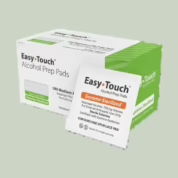
- Alcohol Swabs: One for the vial stopper + one for the injection site each day.
- Per course: 40 swabs
- One 100-count box covers two courses
Protocol Overview
Concise summary of the 20-day course regimen.
- Goal: Support immune system modulation and cellular regulation through bioregulatory peptide signaling.
- Schedule: One daily subcutaneous injection for a 10–20 day course (10-day short course, 20-day standard); repeat two to three times per year with at least 3 months between courses.
- Dose Range: 200 mcg–1 mg daily; 500 mcg for Days 1–3, then 1 mg. 200 mcg is the conservative floor.
- Reconstitution: 2.0 mL BAC per labelled 20 mg vial; nominal 10 mg/mL under the stated final-volume assumption.
- Storage: Lyophilized: refrigerate or freeze; reconstituted: refrigerate for up to 30 days.
Dosing Protocol
Suggested 10–20 day course (Khavinson-style bioregulator schedule; 20 days standard).
- Start: 500 mcg (0.5 mg) daily for Days 1–3 to assess tolerance.
- Target: 1000 mcg (1 mg) daily from Day 4 through Day 20.
- Frequency: Once per day (subcutaneous).
- Course Length: 10–20 days (10-day short course, 20-day standard); 2–3 courses per year with at least 3 months between courses. Do not extend continuously.
- Timing: Any consistent time; rotate injection sites daily.
- Conservative floor: 200 mcg (2 units) daily is the lowest dose presented.
Storage Instructions
Proper storage preserves peptide quality and stability.
- Lyophilized: Store at 4 °C (39.2 °F) or −20 °C (−4 °F) in dry, dark conditions; minimize moisture exposure.
- Reconstituted: Refrigerate at 4 °C (39.2 °F); stable for approximately 30 days.
- Bacteriostatic Water: Discard multi-use vials 28 days after opening per USP standards.
- Allow vials to reach room temperature before opening to reduce condensation and moisture uptake.
Important Notes
- Practical considerations for consistency and safety.
- Use new sterile insulin syringes for each injection; dispose in a sharps container.
- Rotate injection sites systematically (abdomen, thighs, upper arms) to reduce local irritation and prevent lipohypertrophy.
- Inject slowly; wait a few seconds before withdrawing the needle.
- Document daily dose, injection site, and any observations to maintain protocol consistency.
- Follow aseptic technique: wash hands thoroughly and cleanse skin with alcohol before each injection.
How This Works
Crystagen (Glu-Asp-Pro) is a synthetic tripeptide bioregulator that acts on immune system cells to support cellular regulation and immune function. Research suggests that thymic-derived peptides and their synthetic analogs can modulate immune responses and support normal cellular function. Similar immunomodulatory peptides have been studied in clinical settings, typically administered via daily subcutaneous or intramuscular injections in short courses. While related thymic peptides have been used at lower microgram doses (e.g., thymogen at 100 mcg/day), Crystagen is typically utilized at higher microgram-to-milligram daily levels for research purposes.
Potential Benefits & Side Effects
Educational observations from preclinical and clinical literature on thymic peptides.
- May support immune system modulation and cellular regulation through bioregulatory peptide mechanisms.
- Related thymic peptides have been studied for immune support in various research contexts.
- Generally well tolerated in research settings; occasional mild injection-site reactions (redness, minor discomfort) may occur with subcutaneous administration.
- Short-course thymic peptide protocols have been documented in clinical literature, typically ranging from 5–10 days to several weeks.
Lifestyle Factors
- Complementary strategies for optimal research outcomes.
- Maintain a balanced, nutrient-dense diet to support overall immune and cellular health.
- Prioritize adequate sleep (7–9 hours) to optimize recovery and cellular regulation.
- Manage stress through appropriate techniques (meditation, exercise, time management).
- Stay hydrated and maintain regular physical activity appropriate to individual capacity.
Injection Technique
General subcutaneous guidance from clinical best-practice resources.
- Choose a fatty subcutaneous area (abdomen, outer thigh, or upper arm) for injection; avoid irritated or scarred skin.
- Clean the vial stopper and skin with alcohol; allow to dry completely.
- Pinch a skinfold (approximately 1 inch) and insert the needle at 45–90° into subcutaneous tissue.
- Do not aspirate for subcutaneous injections; inject slowly and steadily.
- Withdraw the needle and apply gentle pressure with clean gauze; do not rub the injection site.
- Rotate sites systematically (spacing at least 1 inch apart) to prevent local irritation or lipohypertrophy.
- Always use a new sterile syringe and needle for each injection; never reuse needles.
Recommended Source
Why Amino Labs?
- Third-party tested: Each batch includes Certificate of Analysis (COA) verifying purity and composition.
- Consistent quality: ISO-aligned manufacturing and handling standards ensure reliable product integrity.
- Cold-chain integrity: Temperature-controlled shipping and storage throughout fulfillment process.
- Research-grade purity: Suitable for educational and research applications requiring high-quality peptides.
Note: Product availability and specifications subject to change. Verify current product details on supplier website.
Browse Amino Labs
Important Note
This content is intended for therapeutic educational purposes only and does not constitute medical advice, diagnosis, or treatment.