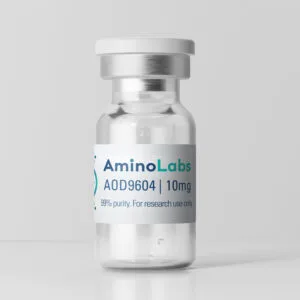
Quickstart Highlights
AOD-9604 is a modified fragment of human growth hormone (residues 176–191) that retains the lipolytic region of the parent hormone without activating the growth-hormone receptor. It was studied in oral and intravenous Phase 2 trials for obesity, where it was well tolerated but did not produce significant weight loss against placebo, and the research community uses it for targeted fat reduction. This educational protocol presents the subcutaneous convention: 250 mcg daily for two weeks, 300 mcg for two weeks, then 500 mcg if tolerated, fasted in the morning, in cycles of 8–12 weeks on and 4–8 weeks off. The 10 mg vial is reconstituted with 2.0 mL bacteriostatic water.
- Reconstitute: Add 2 mL bacteriostatic water → 5 mg/mL concentration.
- Dose range: 250–500 mcg (0.25–0.5 mg) once daily, subcutaneously, in the morning while fasted (8–12 weeks on, then 4–8 weeks off).
- Easy measuring: At 5 mg/mL, 1 unit = 0.01 mL = 50 mcg on a U-100 insulin syringe.
- Storage: Lyophilized: freeze at −20 °C (−4 °F); after reconstitution, refrigerate at 2–8 °C (35.6–46.4 °F) and use within 28 days.
- Vial yield: At 5 mg/mL the vial holds about 33 doses at 300 mcg or 20 doses at 500 mcg; with the 28-day discard window, an 8-week cycle uses about 3 vials and a 12-week cycle about 4.
Dosing & Reconstitution Guide
Standard Protocol (2 mL = 5 mg/mL)
| Week | Dose | Calculated volume | U-100 scale value (1 mL capacity) | V1 nominal setting (units) |
|---|---|---|---|---|
| Weeks 1–2 | 250 mcg (0.25 mg) | 0.05 mL | 5 units | 5 units |
| Weeks 3–4 | 300 mcg (0.3 mg) | 0.06 mL | 6 units | 6 units |
| Week 5 onward (if tolerated) | 500 mcg (0.5 mg) | 0.1 mL | 10 units | 10 units |
Calculation basis: The table uses the labelled 10 mg amount and assumes a final solution volume of 2 mL (5 mg/mL). BAC volume does not change the amount of peptide. These are nominal calculations, not validation of preparation, compatibility or treatment.
Frequency: Once daily, in the morning on an empty stomach, 30–60 minutes before food or exercise. At 500 mcg/day the dose may be split as 250 mcg morning and 250 mcg evening.
Cycle: 8–12 weeks on, then 4–8 weeks off.
Reconstitution Steps
- Allow the vial to reach room temperature before opening to minimize condensation.
- Draw 2 mL bacteriostatic water with a sterile syringe.
- Inject slowly down the vial wall to minimize foaming; avoid shaking.
- Gently swirl or roll the vial until the powder is fully dissolved.
- Label the vial with the reconstitution date and refrigerate at 2–8 °C (35.6–46.4 °F), protected from light.
- Use reconstituted solution within 28 days for maximum potency and safety.
Important: This guide is for educational purposes only and is not medical advice. For research use only. Not for human consumption.
Supplies Needed
Plan based on an 8–12 week once-daily protocol, stepping from 250 mcg through 300 mcg to 500 mcg from week 5.
- Peptide Vials (AOD-9604, 10 mg each):
- 8 weeks ≈ 3 vials (21.7 mg total used)
- 12 weeks ≈ 4 vials (35.7 mg total used)
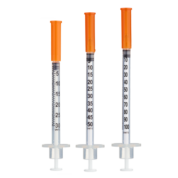
- Insulin Syringes (U-100):
- Per week: 7 syringes
- 8 weeks: 56 syringes
- 12 weeks: 84 syringes
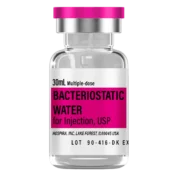
- Bacteriostatic Water (30 mL bottles): Use 2 mL per vial for reconstitution.
- 8 weeks (3 vials): 6 mL → 1 × 30 mL bottle
- 12 weeks (4 vials): 8 mL → 1 × 30 mL bottle
Note: Use bacteriostatic water within 28 days after opening; a vial reconstituted more than 28 days after the bottle was first opened needs a new bottle.
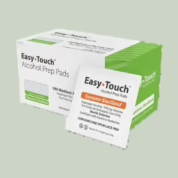
- Alcohol Swabs: One for the vial stopper + one for the injection site each injection.
- 8 weeks: 112 swabs → recommend 2 × 100-count boxes
- 12 weeks: 168 swabs → recommend 2 × 100-count boxes
Protocol Overview
Concise summary of the once-daily regimen.
- Goal: Support targeted fat reduction through the lipolytic growth-hormone fragment without raising IGF-1, glucose or insulin.
- Schedule: Daily subcutaneous injections in the morning, fasted, for 8–12 weeks, followed by a 4–8 week break.
- Dose Range: 250 mcg (0.25 mg) once daily for weeks 1–2, 300 mcg (0.3 mg) once daily for weeks 3–4, then 500 mcg (0.5 mg) once daily from week 5 if tolerated.
- Reconstitution: 2 mL per 10 mg vial (5 mg/mL) for accurate unit measurements on standard insulin syringes.
- Storage: Lyophilized frozen at −20 °C (−4 °F); reconstituted refrigerated at 2–8 °C (35.6–46.4 °F); use within 28 days; avoid repeated freeze–thaw cycles.
- Evidence: Human RCTs exist only for oral and intravenous dosing (Phase 2/2b, safe but no significant weight loss versus placebo); the subcutaneous 300 mcg fasted convention is consistent across sources but has no human pharmacokinetic or efficacy data, so confidence is medium for the convention and low for efficacy.
Dosing Protocol
Suggested daily approach based on oral-trial safety data and research-community conventions.
- Weeks 1–2: 250 mcg (0.25 mg) once daily to establish tolerance; at 5 mg/mL this is 5 units (0.05 mL).
- Weeks 3–4: 300 mcg (0.3 mg) once daily, the modal figure across sources; 6 units (0.06 mL).
- Week 5 onward (if tolerated): 500 mcg (0.5 mg) once daily; 10 units (0.10 mL). Sources describe this as the upper community dose, and the oral trial found no added benefit above about 1 mg/day.
- Frequency: Once per day (subcutaneous injection). At 500 mcg/day the dose may be split as 250 mcg in the morning and 250 mcg in the evening.
- Timing: Morning on an empty stomach, 30–60 minutes before food or exercise. One evidence review notes that the fasted-timing rationale (insulin suppressing lipolysis) has not been demonstrated for this compound.
- Cycle: 8–12 weeks on, then 4–8 weeks off. Sources range from 8 to 16 weeks on, and none of the cycle lengths is evidence-based.
- Maintenance: Hold the tolerated dose for the remainder of the cycle; no further escalation is described.
Storage Instructions
Proper storage preserves product quality and efficacy.
- Lyophilized (powder): Store at −20 °C (−4 °F) in a dry, dark place; for short-term storage (under a few months), 2–8 °C (35.6–46.4 °F) refrigeration is acceptable. Avoid humidity to prevent degradation.
- Reconstituted (solution): Refrigerate at 2–8 °C (35.6–46.4 °F) and do not freeze; use within 28 days. One source quotes 30–60 days of refrigerated stability, but 28 days is the conservative consensus used here.
- Allow vials to reach room temperature before opening to minimize condensation uptake.
- Protect the solution from light. Bacteriostatic water inhibits bacterial growth but does not extend potency beyond the 28-day window.
Important Notes
Practical considerations for consistency and safety.
- Use new sterile insulin syringes for each injection; dispose in a proper sharps container.
- Rotate injection sites systematically (abdomen, thighs, upper arms) to reduce local irritation and avoid lipohypertrophy.
- Inject slowly and steadily; wait a few seconds before withdrawing the needle to ensure complete delivery.
- Keep the fasted morning timing consistent; dose at the same time each day and log the dose and injection site.
- Not approved as a drug by Health Canada, the FDA or any regulator; sold for research use only. AOD-9604 holds self-affirmed GRAS status as a food ingredient in the US, which some sources cite as a safety marker, but that status does not cover injection.
- Evidence caveat: all human trials used oral or intravenous dosing, and the sponsor halted the program in 2007 after the 24-week Phase 2b (n=502) showed no significant weight loss versus placebo; subcutaneous dosing is extrapolated and long-term subcutaneous safety is unstudied.
- One source suggests baseline labs (glucose, HbA1c, lipids, IGF-1, thyroid); trials reported no change in IGF-1 or blood glucose.
- Plan vials around the 28-day discard window: the first vial covers the four weeks at 250–300 mcg, and the 500 mcg phase uses a fresh vial every 20 days.
How This Works
AOD-9604 is a modified 16-amino-acid fragment of human growth hormone, corresponding to residues 176–191 of the C-terminus with an added tyrosine. This region carries the hormone’s lipolytic activity. The fragment mimics it by upregulating beta-3 adrenergic receptor signaling in adipocytes, increasing fat oxidation and reducing lipogenesis, while it does not bind the growth-hormone receptor; IGF-1, glucose and insulin were unaffected in trials. Animal studies support the lipolytic effect. In humans, a 12-week oral Phase 2 study of about 300 adults found that 1 mg/day produced the greatest weight loss versus placebo, but the subsequent 24-week Phase 2b (n=502) found no significant difference and development stopped in 2007. No human subcutaneous pharmacokinetic or efficacy data exist; the 250–500 mcg subcutaneous schedule is a research-community extrapolation, and the fasted-morning timing rests on the general observation that insulin suppresses lipolysis rather than on trial evidence.
Potential Benefits & Side Effects
Observations from oral-trial literature, animal data and research-community reports.
Potential Benefits:
- Lipolysis and reduced fat storage via the GH fragment 176–191 without GH-receptor activation; no IGF-1 or blood-glucose effect was reported in trials.
- In a 12-week oral Phase 2 study of about 300 adults, 1 mg/day produced the greatest weight loss versus placebo; the later 24-week Phase 2b (n=502) found no significant difference.
- Community reports describe gradual reduction in stubborn body fat over 6–12 weeks with diet and exercise; these are anecdotal.
- Cartilage and joint-repair interest from intra-articular research, cited by some sources; AOD-9604 is often combined with BPC-157 in joint protocols.
- Good tolerability in human trials, with no hormonal suppression or insulin resistance reported.
Potential Side Effects:
- Injection-site redness or tenderness (most common with the subcutaneous route).
- Headache, fatigue, dizziness, mild nausea and flushing (trial and community reports).
- At oral trial doses: nasopharyngitis, diarrhea, flatulence, increased appetite and back pain.
- No hormonal suppression or insulin resistance reported; long-term subcutaneous safety has not been studied.
Lifestyle Factors
Complementary strategies for fat-loss goals.
- Maintain a modest calorie deficit with adequate protein intake (1.2–1.6 g/kg body weight) to preserve lean mass; the community fat-loss reports all assume diet is controlled.
- Combine resistance training (2–3 days per week) with aerobic exercise; several sources time the fasted morning dose before a training session.
- Keep the dose-to-meal gap consistent (30–60 minutes) so that day-to-day comparisons are meaningful.
- Prioritize 7–9 hours of sleep and manage stress; both influence appetite and fat storage independently of any compound.
- Track body measurements, photos and weight weekly rather than daily, since the reported changes are gradual over 6–12 weeks.
Injection Technique
General subcutaneous injection guidance from clinical best-practice resources.
- Clean the vial stopper and chosen skin site with separate alcohol swabs; allow both to dry completely before proceeding.
- Pinch a fold of skin between your fingers; insert the needle at a 45–90° angle into the subcutaneous tissue (fatty layer, not muscle).
- Do not aspirate (pull back the plunger) when giving a subcutaneous injection.
- Inject the solution slowly and steadily; wait at least 6 seconds after injection before withdrawing the needle to ensure complete delivery and minimize leakage.
- Withdraw the needle and apply light pressure with a clean swab; avoid rubbing vigorously.
- Rotate injection sites systematically (abdomen, thighs, upper arms) to prevent lipohypertrophy and maintain consistent absorption.
- Dispose of used syringes and needles immediately in a proper sharps container.
Recommended Source
We recommend Amino Labs for high-purity AOD-9604 (10 mg vials).
Why Amino Labs?
- Third-party tested: Each batch includes Certificate of Analysis (COA) verifying purity and composition.
- Consistent quality: ISO-aligned manufacturing and handling standards ensure reliable product integrity.
- Cold-chain integrity: Temperature-controlled shipping and storage throughout fulfillment process.
- Research-grade purity: Suitable for educational and research applications requiring high-quality peptides.
Note: Product availability and specifications subject to change. Verify current product details on supplier website.
Important Note
This content is intended for therapeutic educational purposes only and does not constitute medical advice, diagnosis, or treatment.